Commercial gym equipment warranties are sold as numbers. The trouble is that the number on the front of the brochure is almost never the number you will actually pay.
Below is a first-party comparison of 14 manufacturers whose commercial warranty terms we opened, read, and recorded on 3 October 2026. It covers what each publisher states about the frame, the parts, the labor, and whether the coverage survives a resale. It is not a ranking, and it deliberately produces no overall score — see Why there is no score.
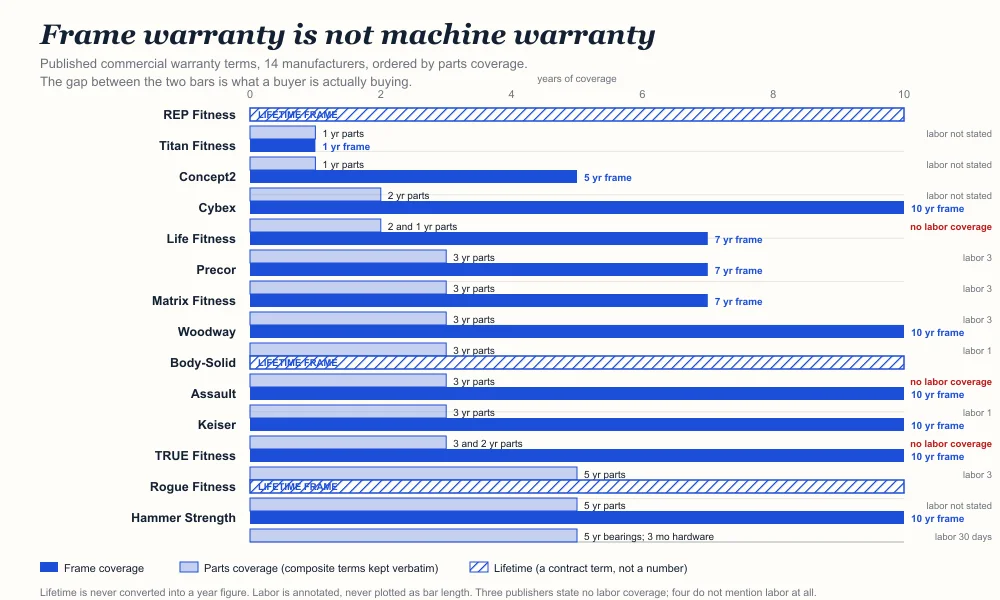
The headline finding: the gap between frame coverage and parts coverage is the whole story. Four of these 14 brands offer a lifetime frame on a one-year parts term. Three offer no labor coverage at all. Seven publish the single word “Parts” without ever saying which parts.
How to read the table
Four conventions apply throughout. They exist because warranty text is written by legal departments, not by buyers, and the gap between the two shows up in the same four places every time.
1. “Lifetime” is a contract term, not a duration. Where a publisher writes “lifetime,” we plot it as a hatched bar running to the edge of the scale and we never convert it to a number. A lifetime frame warranty has no year count attached to it, so averaging it against a ten-year term produces a number that means nothing.
2. Composite parts terms are kept verbatim. Several publishers assign different years to different components in the same sentence — “bearings 5 years; hardware, mechanical, electrical 3 months.” We print those strings as written rather than collapsing them to a single figure. In the chart below, the bar length shows the longest component term in the group; the label shows the full string.
3. Labor is annotated, never plotted as bar length. Whether a technician’s time is covered is a separate commercial fact from which parts are covered. Adding it to the bar would produce a composite number that describes nothing real. So labor appears as a separate note on the right.
4. Silence is recorded as silence. If a publisher does not mention labor, we do not infer that labor is excluded. We write “labor not stated,” which is a different and more actionable finding than either coverage or exclusion.
The case against reading the frame number
The clearest single illustration in this dataset is not a premium brand. It is a pair.
REP Fitness warrants its rack and functional-trainer frames for lifetime and its pop-pins, pulleys, bearings, and cables for one year. Titan Fitness warrants its frames for one year and all parts for one year.
A buyer comparing the front page of these two documents sees “Lifetime” on one and “1 year” on the other, and reasonably concludes the first machine will cost less to keep. On the published terms, the rack’s moving hardware — the parts that actually take load and actually fail — carries one year of coverage in both cases.
The frame is the cheapest component in the machine and the least likely to be the reason you replace it. Warranties are written the way they are because a frame that fails is rare, expensive, and embarrassing; a cable that stretches is neither. The frame number tells you almost nothing about your five-year cost of ownership, and treating it as the headline is the single most common way buyers overpay for a warranty that will not be used.
The published terms
All 14 rows below were read from the manufacturer’s own warranty page or policy PDF on 3 October 2026. Source links are at the end.
| Manufacturer | Equipment | Frame | Parts | Labor | Transfer on resale |
|---|---|---|---|---|---|
| REP Fitness | Rack & functional trainer frames | Lifetime | 1 yr — pop-pins, pulleys, bearings, cables | Not stated | Non-transferable |
| Titan Fitness | All products | 1 yr | 1 yr | Not stated | Non-transferable |
| Concept2 | RowErg / SkiErg / BikeErg | 5 yr | 2 yr — “moving parts and on the monitor” | Not stated | Not stated in source |
| Cybex | Strength products | 10 yr | 2 yr — rotary bearings, guide rods, pulleys, weight stacks, bushings, linear bearings, bars, handles; 1 yr — cables and belts | No coverage stated | Non-transferable |
| Life Fitness | Aspire / Integrity / Symbio treadmills | 7 yr | 3 yr — “Parts (Electrical & Mechanical)”; motor 7 yr | 3 yr | Non-transferable |
| Precor | 800 / 700 / 600 / 500 series cardio | 7 yr | 3 yr; motor 5 yr; console & screen 3 yr | 3 yr | Non-transferable |
| Matrix Fitness | Onyx / Performance / Endurance / Lifestyle cardio | 7 yr | 3 yr — motors, electronics, consoles, TVs, pulleys, grips, pedals, bearings unless otherwise noted | 3 yr | Non-transferable |
| Woodway | Commercial treadmills | 10 yr | 3 yr — “Remaining Parts”; drive, belt, motor 5 yr | 1 yr | Non-transferable |
| Body-Solid | Pro Clubline full commercial | Lifetime | 3 yr — pulleys, bushings, bearings, hardware, plates, guide rods; 1 yr — cables, upholstery, grips | ”does not cover labor costs” | Non-transferable |
| Assault Fitness | Elite Bike / Runner / Rower | 10 yr | 3 yr — “Mechanical Parts”; console 1 yr | 1 yr | Transfer letter required; effect on resale not stated |
| Keiser | Strength equipment | 10 yr | 3 yr — cylinders, displays, processor boxes, thumb buttons; 2 yr — compressor and dryer, cables, pulleys, bearings | ”not responsible for labor charges” | Not stated for strength equipment |
| TRUE Fitness | VAPOR / APEX limited-use cardio | 10 yr (with registration) | 5 yr; tread belt & deck 5 yr; consoles 3 yr | 3 yr (with registration) | Non-transferable |
| Rogue Fitness | Structural welds and frames | Lifetime | 5 yr — bronze bushings, pillow block bearings, pulley wheels; cables, guide rods, sealed roller bearings | Not stated | Non-transferable |
| Hammer Strength | Plate loaded | 10 yr | 5 yr — bearings; 3 months — hardware, mechanical, electrical | 30 days out of box | Non-transferable |
Two details in that table deserve to be read twice.
Hammer Strength’s labor term is 30 days, out of box. The same page carries a warranty table listing labor at three months. The three-month row is a superseded historical term; the operative figure for commercial strength is 30 days from delivery. This is exactly the kind of internal inconsistency that makes a brochure dangerous to rely on, and it is the reason the underlying record stores both values rather than one.
Two of the most-cited brands in the industry say nothing about resale at all. Concept2’s published warranty contains no resale or transfer clause. Keiser’s strength warranty says nothing about transfer either. This is discussed further below, because “silent” is not the same as “permitted.”
NordicTrack: the brand to check first
Before any of the above, one screening question eliminates a category of problem entirely.
NordicTrack’s warranty is warranted for use “within a private, domestic, non-fee paying environment” and expressly does not cover non-home use including commercial, professional, rental, or institutional use. It is a consumer home-use warranty that happens to appear on equipment sold under commercial-sounding names.
This is not a warranty comparison problem; it is a fit-for-purpose problem. No amount of negotiating improves the position of a facility that bought a home-use machine and then ran it for paying members. Confirm the use classification before you compare terms.
When labor is excluded, three costs remain
Six of the 14 publishers do not give you full labor coverage. Three say so outright: Body-Solid’s terms state they do not cover labor costs, Cybex’s state there is no warranty coverage for labor on strength products, and Keiser’s state they are not responsible for labor charges. Three more cover a year or less: Assault Fitness and Woodway at one year, Hammer Strength at 30 days out of box.
A covered failure under these terms does not become free. It becomes a cost with three separate components:
- The part itself. Whether the manufacturer ships it free or you buy it and claim reimbursement changes the cash position on the day of failure, and warranty text usually does not say which applies. Ask.
- The labor. This is the uncovered component by definition. Its size depends entirely on who is authorized to work on the machine and where they are.
- The delay. Whether a covered part ships to you, to a dealer, or to a regional service center is the difference between a machine that is down for an afternoon and one that is down for a month.
None of the three can be read off a warranty table. All three are answerable, but only in writing, before purchase. That single email is worth more to a buyer than any number in the table above.
Lifetime frames are three different promises
Three of these publishers write “lifetime” on the frame: REP Fitness, Body-Solid, and Rogue Fitness. They mean three different things.
REP’s lifetime term appears alongside a footnote-marked limited lifetime and separate 10-year term for bench frames. Rogue’s lifetime applies specifically to structural welds and frames as distinct from its 5-year parts schedule. Body-Solid’s lifetime covers frame and welds, sitting above a 3-year parts term and a 1-year term for cables, upholstery, and grips.
Then there is the meaning of “lifetime” itself. Lifetime warranty terms in this industry are generally limited by time, transferability, and sometimes by geography or by the owner’s conduct. A frame warranty that requires the original purchaser, does not travel with a sale, and requires evidence of service is a real warranty — it is just not a long one.
The practical consequence is that a lifetime frame term cannot be used to estimate how long you can keep the machine. It tells you the frame is covered for as long as you own it, under conditions. Whether you keep it is a different question, and it depends on the parts and labor terms underneath.
Transferability is three states, and the middle one is a trap
Sorting the 14 manufacturers by what they publish about resale gives three groups:
Explicitly non-transferable (11): Body-Solid, Cybex, Hammer Strength, Life Fitness, Matrix Fitness, Precor, REP Fitness, Rogue Fitness, TRUE Fitness, Titan Fitness, Woodway.
Transfer letter required, resale effect not stated (1): Assault Fitness’s terms call for a transferred warranty letter but do not say whether the warranty survives a resale at all.
Not stated (2): Concept2 and Keiser’s strength equipment.
The third group is the one that causes disputes. A warranty that does not mention resale has not granted permission to resell the covered unit. Absence of a prohibition is not a permission, and in a sale the burden of proof sits with whoever is relying on the coverage. If you are buying used equipment whose warranty is one of the two silent ones, get the answer from the manufacturer in writing before you pay, not from the seller’s assurance afterward.
There is also a distinction worth making inside the “non-transferable” group. “Non-transferable” and “warranty begins on original purchase date and does not follow the asset” are different clauses. A machine that was bought three years ago and sold to you today may carry a warranty that is still running — or one that ended with the first owner. Nothing on the front page tells you which.
The reason to separate the frame term from everything else is that resale value does not follow the warranty clock. A machine with nine years left on a transferable frame warranty can still be hard to sell, because the buyer is really asking whether the part is still made, what it costs, and who can fit it. That gives an editorial shorthand we use internally, and which we offer as a heuristic rather than a measurement:
Resale resilience is not remaining warranty.
Resale resilience tracks parts support, repair identifiability, price visibility, and service access — in roughly that order of weight — and tracks remaining warranty barely at all.
Neither expression is a validated model and neither should be quoted as one. It is a way of keeping the frame term in its proper place: as the least predictive of the four numbers a used-equipment buyer actually cares about.
The four parts-support bands
This is the part of the comparison that has the longest reach, because it determines what happens in year eight rather than year one. Two facts are available for every manufacturer: whether the parts term is itemized by component, and whether the publisher says anything about supporting the product after discontinuation.
| Band | What the publisher documents | Manufacturers |
|---|---|---|
| A | Parts itemized, and a stated post-discontinuation support policy | Cybex |
| B | Parts itemized, nothing stated about after discontinuation | Body-Solid, Hammer Strength, Keiser, Matrix Fitness, REP Fitness, Rogue Fitness |
| C | Parts term not itemized, but a stated support policy for older units | Concept2 |
| D | Parts term not itemized, nothing stated about after discontinuation | Assault Fitness, Life Fitness, Precor, Titan Fitness, TRUE Fitness, Woodway |
Band A is a single manufacturer, and the reason is specific: Cybex publishes parts diagrams with a per-part price lookup, and states support for at least seven years after discontinuation, sometimes longer. That is the only combination in this set that lets a buyer price a repair before it happens.
Band C is Concept2, which states that all vintage equipment is supported with parts and manuals, without publishing a fixed year count, and notes that part numbers are findable though some pages require contacting them for price.
Band D is the largest and the quietest. Six manufacturers publish no parts policy for discontinued products at all. In most cases this is not refusal — the page simply does not address it. Precor’s terms say parts remain orderable but publish no fixed post-discontinuation period. The rest are silent.
The four hours you will spend on a replacement motor in year eight will be spent discovering whether a part exists, what it costs, and who may install it. Bands A and C answer the first two. Nothing on any warranty page answers the third.
Why there is no score
It would be easy to weight frame coverage, parts coverage, labor, and support into a single number per manufacturer and sort them. We are not going to, for three reasons.
The inputs are not commensurable. “Lifetime” has no numeric value. A parts term of “bearings 5 years; hardware 3 months” has no single value. Adding them requires inventing the numbers you claim to be measuring.
The labor question dominates the total and is not in the table. Whether a technician’s time is covered changes the cost of a failure more than any warranty term does, and it changes by a different multiplier at every facility depending on local service rates.
Absence of a published policy is not evidence of a bad one. Four of the manufacturers in Band D may support discontinued parts perfectly well. They have not published it. Scoring silence as a defect would be inventing a finding.
What we publish instead is the decision method: identify the component most likely to fail on your equipment mix, find its term in the table above, then ask the dealer the four questions the warranty does not answer.
What still has to be asked
Five things none of these 14 documents resolve, all of which belong in a written pre-purchase exchange:
- Does the manufacturer supply the part free, or is it bought and reimbursed? This changes your cash position on the day of failure.
- Who is authorized to perform the work? Warranty labor is frequently void if an unaffiliated technician opens the machine.
- Is the warranty prorated, and from what start date — purchase, delivery, or installation?
- Are consumables excluded beyond the wear-item list? Cables, belts, grips, pads, and upholstery age on a schedule unrelated to the warranty clock.
- Does anything change on registration or a limited-use designation? TRUE Fitness’s published term is conditioned on registration, which means the coverage depends on an administrative act.
A resale-specific sixth: ask the manufacturer, in writing, whether coverage follows the unit and from what date. Sellers are not the authority on this.
Buying used: five questions before you commit
- Is the serial number legible, and does the build date fall inside any registration or limited-use condition? A limited-use warranty is void the moment the unit enters a different environment.
- Does the warranty follow the unit? Ask the manufacturer directly, citing the serial number. Do not rely on the seller’s summary.
- What is the documented service history? A gap is not proof of neglect, but a record shortens the argument if one starts.
- Which components are actually fitted? For cardio, confirm the controller and motor are the parts the published term names — aftermarket or superseded controllers are a common exception.
- What is the part number of the single most likely failure, and is it still orderable? This one question converts an unknown into a price, and it is the question most worth asking.
A checklist you can send
Before we place this order, please confirm in writing:
- The frame, parts, and labor terms for the exact model and serial range quoted.
- Whether the warranty is transferable and, if so, from what date.
- Whether covered parts are supplied free of charge or purchased and reimbursed.
- Which technicians or dealers are authorized to perform warranty work in our area.
- The part number and current price for the most commonly replaced component on this model.
- Your parts support policy for this product line after discontinuation.
- Whether any term above is conditioned on registration or on limited commercial use.
Send all seven in one message, and ask for the reply in writing.
Seven questions. Every answer is a document you can hold. None of them can be found on a brochure.
Questions buyers ask
Is a lifetime frame warranty worth paying for? Not on the frame number alone. Lifetime frame coverage sits above a parts term that is often much shorter — REP Fitness pairs a lifetime rack frame with a one-year parts term, and Body-Solid pairs a lifetime frame with three years of parts and one year on cables, upholstery, and grips. Judge the parts, labor, and after-discontinuation terms, then treat the lifetime frame as what it is: the least predictive of the four.
Which commercial gym equipment brands publish no labor coverage? Three of the 14 in this comparison state it outright — Body-Solid, Cybex, and Keiser. Three more give you a year or less: Assault Fitness and Woodway at one year, and Hammer Strength at 30 days out of box. Four others do not mention labor at all, which is a different finding from exclusion.
Is a warranty automatically void when you resell the machine? Often yes, and the answer is not always on the page. Eleven of these publishers state the warranty is non-transferable. Assault Fitness requires a transferred warranty letter but does not say whether coverage survives a resale. Concept2 and Keiser’s strength terms do not mention resale either, and silence is not permission — if you are buying used, ask the manufacturer directly with the serial number.
How do I check whether a part will still be available in ten years? Look for three things in the publisher’s own documentation: a parts diagram with a per-part price lookup, a stated post-discontinuation support period, and part numbers that are findable without opening a dealer account. Among these 14, only Cybex publishes all three. Four publishers say nothing at all about support after discontinuation, which is not the same as refusing support, but it is a question worth putting in writing.
Do warranty terms differ between home and commercial use? Yes, and the difference can be total. NordicTrack’s warranty is limited to use “within a private, domestic, non-fee paying environment” and expressly excludes non-home use including commercial, professional, rental, or institutional use. TRUE Fitness’s published term is conditioned on registration. Always confirm the use classification and any registration condition before you compare terms.
Scope, and what this article does not claim
This is a record of published terms, not an assessment of any manufacturer, and not a ranking. Four additional manufacturers appear in our warranty records — Panatta, Technogym, Eleiko, and Nautilus — but they were captured through secondary summaries rather than a first-party document we could cite, so they are excluded from every cross-manufacturer comparison here and are not represented in the chart or the table.
Within the 14, seven publishers itemize their parts schedule by component and seven do not. Where a publisher writes only “Parts,” we record exactly that and do not infer coverage for bearings, cables, or anything else. Warranty terms change without notice and vary by region, model, and date of purchase. Everything above reflects what each publisher stated on the day it was checked, and should be verified against your own dealer in writing before you sign anything.
Sources
All retrieved and read on 3 October 2026. These are manufacturer documents we cite as evidence, and listing a warranty is not an endorsement of the brand. They are printed as plain text rather than hyperlinks, so no link equity passes to any of the domains involved.
- Assault Fitness — Precor North America warranty policy PDF (Elite series terms):
https://static.precor.com/PDF/Precor-Warranty-NA.pdf - Body-Solid — Full Commercial Warranty:
https://bodysolid.com/body-solid-full-commercial-warranty/ - Concept2 — Product Warranties:
https://concept2.com/support/product-warranties - Cybex — Strength Products warranty PDF:
http://kb.cybexintl.com/Owners_Manuals/Strength/55399.pdf - Hammer Strength / Life Fitness — Strength warranties:
https://www.lifefitness.com/en-us/customer-support/service/warranties/strength - Keiser — Warranty:
https://www.keiser.com/support/warranty - Life Fitness — Cardio warranties:
https://www.lifefitness.com/en-us/customer-support/service/warranties/cardio - Matrix Fitness — Commercial cardio sell sheet PDF:
https://assets.johnsonhealthtech.com/asset/29b17b1a-f73d-4e0c-8e58-89968bc6760c/mx26_sell_sheet_na_matrix_commercial_cardio.pdf - NordicTrack — Warranty information:
https://www.nordictrack.com/uk/warranty-information - Precor — North America warranty policy PDF:
https://static.precor.com/PDF/Precor-Warranty-NA.pdf - REP Fitness — Warranty information:
https://repfitness.com/pages/warranty-information - Rogue Fitness — Warranty:
https://www.roguefitness.com/warranty - TRUE Fitness — VAPOR / APEX owner’s manual and warranty PDF:
https://truefitness.com/wp-content/uploads/2026/03/MAN-TC1-IA-35-REV08-OWNERS-MANUAL-AND-ASSEMBLY-GUIDE.pdf - Titan Fitness — Warranty:
https://titan.fitness/pages/warranty - Woodway — Owner’s manual PDF:
http://en.woodway.com/productmanuals/WOODWAYOwnersManual_REV8.21.13.pdf