Every gym floor is priced twice — once on the way in, and once on the way out. Most operators plan the first price carefully and treat the second as an afterthought. That is the mistake this report exists to correct.
New equipment is priced on hope. Used equipment is priced on proof. The secondary market for commercial fitness equipment is not a bargain bin where distressed clubs dump iron — it is the market where depreciation gets audited. Every floor loses value on a schedule, and the resale market is the mechanism that converts that depreciation back into capital. The price a machine fetches is its residual value made public — the exact number a CAPEX model quietly assumes in year zero and rarely tests in year five. See our fitness asset intelligence methodology for the wider CAPEX framework this report sits inside.
Read as an asset market, the resale price is a receipt. It does not care what you paid, which brand you trusted, or what the sales rep promised. It prices three things: the corridor you sell through, the grade of the unit, and the category it belongs to. Everything else is a modifier.
One disclosure up front, because it governs every number below: this is an intelligence report, not a census. Market-size figures, recovery percentages, and refurbishment costs in this space are estimates, and single-point absolutes are a warning sign, not a finding. Every figure here is graded or banded, dated (Q4 2025 estimates unless noted), and confidence-tiered (low / medium / high). Where the data is thin, that is stated, not smoothed.
The market you are actually in
English-speaking operators carry two distorted frames about the secondary market, and both distort CAPEX decisions.
The first is consumer contamination. Because home-gym flipping is loud — Facebook Marketplace, garage arbitrage, forum threads trading squat racks — many US and UK operators quietly assume the commercial secondary market is the same thing: amateur, risky, small-money. It is not. The commercial secondary market is institutionalized. Dealers run trade-in and buy-back programs against new-fleet purchase orders. Specialist refurbishers re-certify equipment to a defined grade and resell it with a warranty. Fleet liquidations move hundreds of units at a time when a chain closes a site or re-images a floor — which is why the same volume economics shape the power rack OEM market from the supply side. Leasing companies price residuals into every contract and own the disposal corridor by default. This is an asset market with intermediaries, not a yard sale.
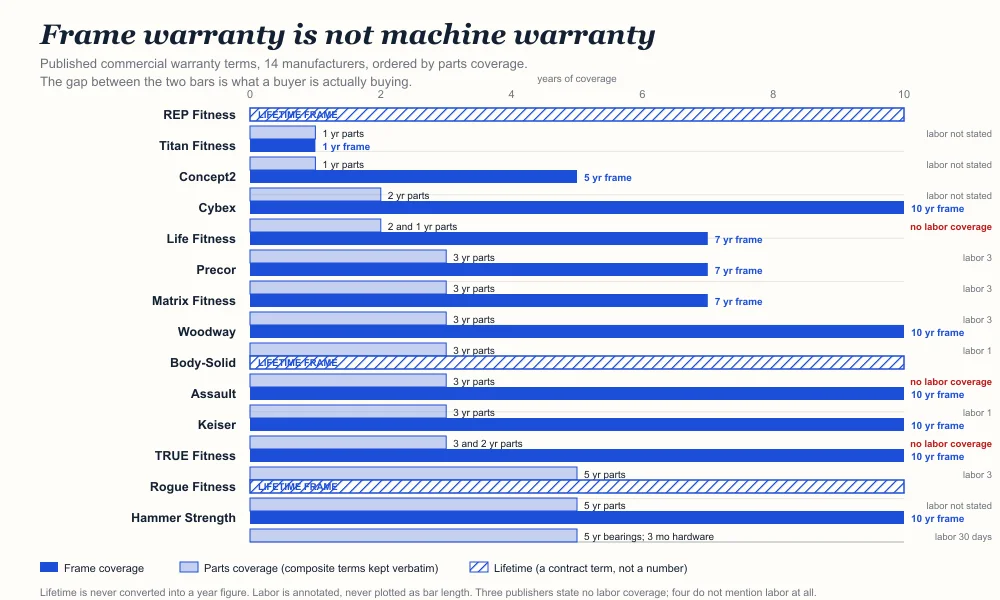
The second frame is the one almost nobody names: the parts-availability cliff. Commercial equipment is bought for a 7–10 year mechanical life, but it is frequently resold into a much shorter parts window — commonly 3–5 years of active manufacturer support (medium confidence; varies sharply by maker and by whether the model line survived). Warranty terms are the one part of this you can check in writing before you buy — see our comparison of published commercial warranty terms. A model that turns out to be short-lived orphans the value of its entire installed base. This is why the question that matters most when valuing a unit is not “what condition is it in?” but “does the manufacturer still stock parts for this unit?” A Tier B machine with full parts support can be worth more than a Tier A machine whose line was discontinued two refresh cycles ago.
A third layer the English surface misses: depreciation is a category-mechanical fact before it is an accounting convention. Straight-line depreciation treats a treadmill and a power rack identically. The market does not. The operator who prices the two categories differently on the day they are bought is the one whose asset register tells the truth.
Price is set by three variables, not by the machine
Strip away the noise and the resale value of any commercial unit resolves to three variables, in this order of impact:
- The corridor — trade-in, refurbisher, or direct resale/auction.
- The grade — Tier A / B / C, set by manufacture date, wear, parts availability, and manufacturer support.
- The category — the mechanical class of the unit.
Brand sits underneath all three as a modifier, not a driver — we hold scored profiles for Life Fitness, Technogym and Matrix, but those scores describe the new unit, not what it resells for. This is where most operator intuition fails: a Tier A mid-tier unit routinely out-prices a Tier C premium machine — the same reversal that shows up in TCO modelling of premium equipment. Grade, not brand, sets the price.
The corridor spread is your biggest controllable lever
The same unit, on the same day, sells for materially different prices depending on the corridor. The spread between corridors is the single largest recovery lever an operator controls — larger than any negotiation over the unit itself.
| Corridor | Relative recovery | Cash speed | Logistics burden | Grade it rewards | Best for |
|---|---|---|---|---|---|
| Trade-in | Lowest band | Fastest (credited against new PO) | Minimal — often vendor-managed removal | Any; it penalizes low grade least because it is not condition-graded line-by-line | Low-grade units, fast floor turnover, sites with no storage or rigging capacity |
| Refurbisher | Mid band | Medium (inspection → offer → collection) | Moderate — grading, sometimes removal | Tier B units that can be re-certified profitably | Re-certifiable units with parts support and intact service history |
| Direct resale / auction | Highest potential band | Slowest (weeks to months) | Highest — you carry removal, storage, listing, and buyer risk | Tier A units, especially strength | Operators with logistics capacity who can carry timeline and removal risk |
(Recovery bands are deliberately unquantified here because they move by category, grade, vintage, and geography. Relative ordering — trade-in < refurbisher < direct — is a stable structural pattern, high confidence. The absolute width of the spread is medium confidence and dated.)
The practical translation: the corridor you sell through moves the price more than the machine you sell. A direct-sale campaign on a Tier A strength floor can recover meaningfully more than accepting a vendor trade-in credit — but only if you can absorb the timeline. If you cannot store, list, and stage removal, the “highest band” is fiction.
Grade: why a Tier A mid-tier unit out-prices a Tier C premium one
Condition grading is the market’s underwriting language. It is not cosmetic. A workable working definition:
- Tier A — Recent manufacture date relative to category life, documented service history, full manufacturer parts support, no structural wear, original electronics functional. Commands the top of its category band.
- Tier B — Mid-life, cosmetically worn, mechanically sound, parts support intact or forecast to remain for the buyer’s holding period. The re-certification candidate.
- Tier C — End of parts support, widespread wear, dated or orphaned electronics. Value sits in salvage and parts, not resale.
Two mechanisms make grade dominate brand. First, documentation moves a unit up a grade. A machine with a service log, replacement-part records, and known maintenance history is a different asset from an identical machine with none. Operators who track service history are, without realizing it, protecting residual value. Second, parts availability is a grading input, not a footnote. The moment a manufacturer signals a model is going out of production, its installed base takes a grade step down — sometimes a cliff rather than a slope (medium confidence on timing; high confidence on direction).
Category residual curves: the mechanical value survives, the software value dies
The single most useful structural fact in this market is that residual value is a category mechanic. Banded, dated recovery estimates (medium confidence, Q4 2025) tell the story:
| Category | 3-yr recovery (band) | 5-yr recovery (band) | Primary driver |
|---|---|---|---|
| Selectorized strength | High | Moderate | Simple mechanics, deep demand, long parts support |
| Plate-loaded | High | Moderate | Even simpler than selectorized; minimal electronics |
| Free weights / dumbbells | Moderate (commodity-priced) | Low–Moderate | Durable, but priced as metal + condition, not as an asset |
| Power rack / benches | Moderate | Low–Moderate | Weld-and-steel; value tracks condition and safety only |
| Mass commercial treadmill | Moderate | Low | Belts, decks, and consoles date the unit faster than the frame wears |
| Other mass cardio (bikes, ellipticals) | Low–Moderate | Low | Same aging mechanism, thinner resale demand |
| Connected / software-locked cardio | Low | Very low | Software obsolescence orphans functional hardware |
The pattern is not subtle. Steel holds; software doesn’t. A power rack’s value is almost entirely mechanical, so it depreciates slowly and predictably. A mass-market commercial treadmill is a frame wearing a belt, a deck, and a console — and those three consumables date the whole unit, which is why slat-belt premium units age on a different curve entirely. A connected treadmill adds a fourth aging layer: proprietary software, firmware, and app dependency. When the manufacturer stops supporting the connected layer, a mechanically functional machine loses most of its market value overnight. The hardware is fine; the asset is dead.
This is why buying used in connected or tech-heavy cardio is where operators get hurt — and why the same operator can buy used strength with confidence. The category, not the discount, determines whether used is safe.
Refurbishment economics: where the numbers get honest
Refurbishment — properly, re-certification — is the process that converts a Tier B unit into a sellable, warrantable Tier A-adjacent unit. It is also where more operators lose money than make it, because they compare the resale price to the purchase price and never build the cost stack.
A re-certification cost stack, in the order it accumulates:
- Consumables — belts, decks, cables, bearings, pads, upholstery.
- Electronics — consoles, control boards, drive components, or replacement of orphaned controllers.
- Finish — powder coat, decals, frame touch-up.
- Safety re-certification — inspection, load/safety testing, and the documentation that lets the unit be sold as re-certified rather than “used.”
- Freight and logistics — inbound to the refurbisher, outbound to the buyer, plus interim storage.
- Downtime — the unit earns nothing while it is in the shop.
The rule is blunt: re-certify only when the resale uplift clears the full stack plus the downtime. If the uplift does not clear it, the unit is Tier C and its value is in the salvage and parts market, not in refurbishment. There is no third path where refurbishment is “worth doing anyway” — “worth it” is a number, not a feeling.
Estimate banding: for proven strength categories with intact parts support and deep demand, re-certification uplift frequently clears the stack (medium confidence). For mass and connected cardio, the stack frequently exceeds the uplift once electronics and freight are included (medium confidence, wider band). This is the category mechanic reasserting itself: refurbishment economics are downstream of the same steel-versus-software split that governs raw residual value.
Depreciation is a category fact before an accounting convention
Here is where the asset register earns its keep. Most operators depreciate their fleet on one straight-line schedule. The market applies at least two. Strength categories depreciate on a long, shallow curve; mass cardio on a steeper one; connected cardio on a curve with a cliff built into it. An asset register that carries a single blended depreciation rate is not conservative — it is inaccurate in both directions, overstating the strength floor’s decay and understating the cardio floor’s.
The operator who prices the two categories differently on the day they are bought is the one whose asset register is honest, whose refresh plan is sequenced correctly, and whose disposal corridor is planned rather than improvised. That is the whole game: the purchase decision and the disposal decision are two halves of one CAPEX model, not two separate events.
The three-part asset rule
This is the decision framework. It is deliberately unhedged — no “it depends.”
(1) Seller. Value the floor before signing the refresh purchase order. Sequence the three corridors by category and grade:
- Trade-in for low-grade units and fast cash — accept the lowest price deliberately, because you are buying speed and removal.
- Refurbisher for Tier B units that can be re-certified profitably — mid price, more logistics.
- Direct resale / auction for Tier A units where you can carry the timeline and the removal risk — potential top price.
Document service history and confirm parts availability before you grade: documentation moves a unit up a grade, and grade sets the price.
(2) Buyer. Compute delivered cost, not sticker. Delivered cost = unit price + transport/rigging + re-commissioning + parts-and-warranty-gap risk. The same whole-of-life logic drives our equipment performance model. Buy used only when delivered cost beats the new-equipment total cost of ownership over the same holding period and the manufacturer still stocks parts for the model. If you are still building the new-equipment side of that comparison, start from our gym investment ROI models. Never buy used in connected or tech-heavy cardio, where software obsolescence orphans the hardware. Prefer used in expansion and replacement of proven strength categories, where mechanical value survives.
(3) Hold-or-exit. Decide per unit, not per floor. If refurbishment uplift clears the cost stack plus downtime, re-certify. If not, part it out or trade it in. If a model’s parts are heading out of production, its residual is about to fall off a cliff — exit early, before the market reprices it for you.
The unifying signal: if you cannot name the corridor, the grade, and the parts status of a unit, you do not know what it is worth. That is the signal to grade the floor before you price it.
Verdict, and who this is for
The verdict line: buy used when delivered cost beats new TCO and the parts are still in production; sell before you refresh, and price the disposal corridor into the purchase decision — not into the surprise line five years later.
Buy used (in this shape):
- Operators expanding or replacing proven strength — selectorized, plate-loaded, free weights, power racks and benches.
- Buyers who can verify parts availability and demand documented service history.
- Multi-site operators who can standardize a category across sites and amortize the logistics.
Do not buy used (in this shape):
- Anyone buying connected or software-locked cardio — the software value dies first and takes the hardware value with it.
- Anyone who cannot confirm the manufacturer still stocks parts for the model.
- Single-unit buyers where transport and rigging erase the discount.
Sell (in this shape):
- Anyone planning a refresh: model the disposal in year zero, sequence corridors by grade, and document the fleet so it grades up. For the inbound side of that refresh, see commercial cardio suppliers.
- Anyone holding a model whose parts are sunsetting: exit early.
The secondary market is not separate from CAPEX strategy. It is the other half of it. What you recover decides what the floor actually cost — and the buyer who models the disposal corridor before signing the purchase order is the one who is not surprised by the number five years later. For the inbound side of that purchase order, our ODM sourcing document checklist covers what to get in writing before you commit; for how the two halves sit inside one asset register, see the fitness asset intelligence series.
FAQ
How much is used commercial gym equipment worth? Worth = residual value, which is set by corridor, grade, and category — not by what you paid. Recovery bands are wide and dated: strength categories recover a large share of original list at 3 years and a moderate share at 5 (medium confidence, Q4 2025); mass cardio recovers substantially less; connected cardio least. Treat any single percentage as invalid — it is a band, by category and grade.
Do gyms buy used commercial fitness equipment? Yes, and institutionally. The commercial secondary market runs on dealer trade-in and buy-back programs, specialist refurbishers selling re-certified units with warranties, fleet liquidations from closures and re-images, and leasing-company residual programs. This is not consumer resale; it is a structured asset market with intermediaries.
Is refurbished gym equipment worth it for a commercial facility? Only when the resale (or use) uplift clears the full re-certification cost stack — consumables, electronics, finish, safety re-certification, freight, and downtime. For proven strength with parts support, that condition frequently holds. For mass and connected cardio, the stack frequently exceeds the uplift, and the unit is really a Tier C salvage case. “Worth it” is a calculation, not a category preference.
How do I sell my old gym equipment for the best price? Grade the floor before you sign the refresh PO. Sequence corridors by grade: trade-in for low-grade units and speed, a refurbisher for re-certifiable Tier B units, direct resale or auction for Tier A units you can carry to a longer timeline. Document service history — it moves units up a grade — and confirm parts status, because grade and support drive price more than brand.
Which gym equipment holds its value best (and which loses it fastest)? Strength holds best: selectorized, plate-loaded, and simple steel (power racks, benches) depreciate slowly because mechanics are simple and demand is deep. Mass cardio loses faster because belts, decks, and consoles date the unit. Connected cardio loses fastest because software obsolescence orphans functional hardware. Residual curves are category mechanics with brand as a modifier — never a brand leaderboard.
What should I check before buying used commercial fitness equipment? Delivered cost (unit + transport/rigging + re-commissioning + parts-and-warranty-gap risk) against new TCO over the same holding period. Parts availability from the manufacturer for the specific model. Grade (manufacture date, wear, documentation, support status). And the category — never buy used connected cardio; prefer used proven strength. If you cannot name the corridor, grade, and parts status of the unit, you do not know what it is worth.