Before you compare the policies, check whether you can read the one that binds you
Most published comparisons of gym cancellation terms are built on a bad assumption: that a national brand publishes a national cancellation policy. In the ten chains we examined for this report, that assumption held for one.
This is not an article ranking cancellation policies. It is an article about whether the agreement governing your membership is publicly readable at all, and at what level it lives — because in a franchised or multi-club structure, “Planet Fitness says X” and “your Planet Fitness agreement says Y” can both be true at the same time.
We attempted to retrieve a current, publicly citable membership agreement from ten major US chains. Three produced a document we could read in full. One of those three was a single club’s agreement, found only because a local page happened to carry it.
Not stated is not the same as no policy. We did not treat an inaccessible agreement, an undated FAQ, a third-party cancellation guide, or an AI-generated quotation as evidence of a current policy. Where we could not locate a current, citable agreement, we report that limitation rather than filling the gap with secondary sources or assumptions.
The five levels between a brand name and your contract
A brand name is not a contract. The document that governs you sits at one of several levels, and which level applies varies by chain — and sometimes by state.
- Brand / corporate terms — published centrally, often covering apps, privacy and acceptable use rather than membership terms.
- The corporate or franchised club — the entity that actually contracts with you.
- The home-club agreement — the specific contract for the club you joined, which is frequently the only document with real cancellation terms.
- Your member-specific contract — the signed version of the above, with the dates and addenda you agreed to.
- State statutory requirements — which can override everything above, and which most national policies never mention.
The economics of that split are covered separately in our analysis of top fitness franchisees and franchisor power dynamics. What matters here is the member-facing consequence: the clearest published evidence for step 2 comes from a document we read in full. The Gold’s Gym membership agreement published on a single location page in Chapman, Tennessee says, in its own words:
Gold’s Gym International, Inc. or any related entity is not the owner or operator of this Gold’s Gym facility. The owner of this facility has been licensed by Gold’s Gym Franchising, Inc.
The contracting party for a member of that club is therefore not the company whose name is on the door. Our equipment and facility profile for Gold’s Gym covers the brand side; the member contract is a separate document held by the licensee.
The availability matrix
Each row records the deepest level at which a citable membership document was reachable. Status is categorical; we did not score any chain.
| Brand | Ownership structure | Primary-source status | Readable agreement found? |
|---|---|---|---|
| Life Time | Corporate-owned clubs | Public national document | Yes — 326,307 characters |
| Equinox | Corporate clubs plus franchise locations | Binding terms at club level only | Yes — 37,211 characters, one club |
| Gold’s Gym | Franchised | Single-club sample only | Yes — 31,261 characters, one club |
| Planet Fitness | Franchised | Behind a WAF challenge | No — access blocked |
| Anytime Fitness | Wholly franchised, no corporate-operated clubs | Behind a WAF challenge | No — access blocked |
| 24 Hour Fitness | Mixed | Corporate paths returned nothing | No |
| LA Fitness | Franchised | Corporate paths returned nothing | No |
| Club Pilates | Franchised | Corporate paths returned nothing | No |
| Crunch | Corporate plus franchised | No current document located | No |
| YouFit | Mixed | No current document located | No |
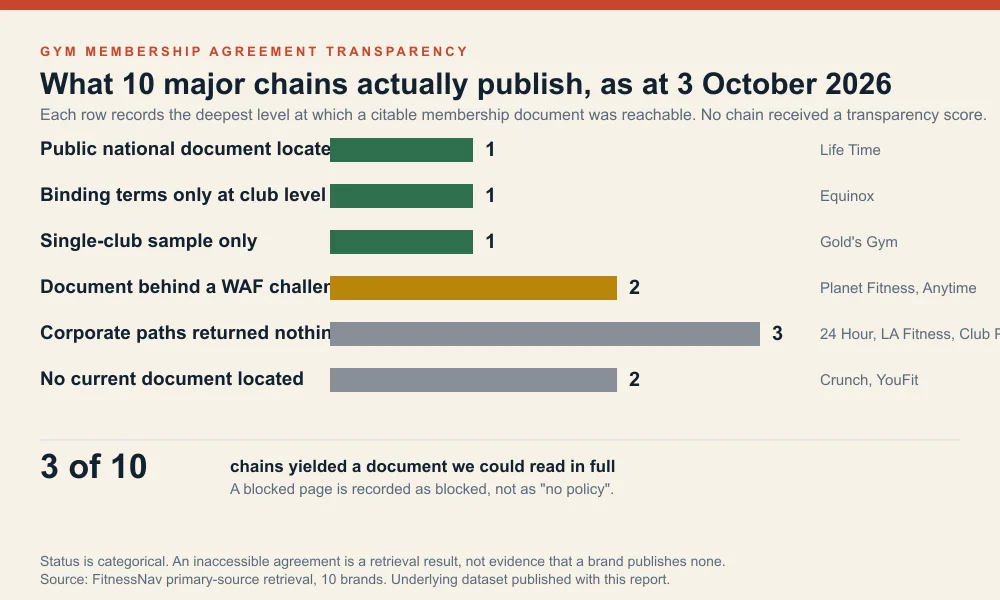
Two distinctions inside that table matter more than the counts.
First, “behind a WAF challenge” and “corporate paths returned nothing” are not the same result. Planet Fitness and Anytime Fitness served a bot-challenge page to our research environment on every path we tried. That is a retrieval outcome about our access, and we record it as one. Readers trying to settle it themselves should start from the Planet Fitness and Anytime Fitness brand pages rather than a corporate policy page, because for both brands the location agreement is the operative document. Twenty-four Hour Fitness, LA Fitness and Club Pilates served their own 404 pages. That is a different outcome, and we record it separately. Neither is evidence that the brand publishes no policy.
Second, only one chain published a national document that actually contains national cancellation terms. Life Time did. Everyone else either had cancellation terms at club level, behind a login, or nowhere we could reach.
Case 1 — Equinox: the national document is silent, the club document is complete
We retrieved and searched the national Terms of Use behind our Equinox profile in full: 54,380 characters. It contains no membership cancellation provision, no notice period, no early termination fee, no annual fee treatment, no auto-renewal clause, and no relocation or medical cancellation exemption. Its only non-transferability language concerns licences to use the app:
Subject to your compliance with these Terms, Equinox gives you the limited, non-exclusive, non-transferable, and revocable right to access and use the Digital Properties solely for your personal and non-commercial use.
The cancellation terms exist. They live in the club-level Join Terms — 37,211 characters, one named club. What that document says:
- Non-transferable. “1.5 Non-Transferable: Your Membership is personal to you and is non-transferable and non-descendible. Only you may use your Membership.”
- Early termination fee, capped. “Equinox may charge you a reasonable cancellation fee, not to exceed 10% of the outstanding Membership Dues for the remainder of your Initial Period or fifty dollars ($50), whichever is less.”
- Notice period: 30 days, and it is a non-renewal notice rather than a mid-term cancellation notice: “if you do not notify Equinox at least 30 days prior to the expiration of your Initial Period, your membership and this Agreement will automatically renew at the end of the Initial Period on a continuous month-to-month basis.”
- Relocation and medical exemption, with evidence required: “you must attach your proof of relocation or a medical note”
- The home club is defined in the contract itself: “Your “Home Club” is the Club at which your Membership was purchased and is listed at the beginning of this Agreement.”
Read together, the two documents make one point that neither makes alone: the national terms are not a summary of the club terms. They are a different document about different things.
Case 2 — Life Time: the national document exists, and it names the state laws that override it
Life Time’s Guest and Club Policy, published alongside our Life Time profile, is the most complete public cancellation document we located — 326,307 characters. It is still not the membership contract.
What makes it valuable is that it embeds state-specific statutory rights rather than pretending one national rule applies. Its convenience-cancellation route runs “through a method provided in your fitness service contract” — the national document itself points back to the club contract for the mechanism.
| State | What the national policy states | Statute named in the document |
|---|---|---|
| Minnesota | Cancellation for convenience is effective immediately and may be made in person, by telephone, by written notice, by email, by online message, or through a statutory termination election | Minnesota Statutes section 325G.60 |
| Connecticut | A three-business-day right to cancel by written notice, separate from the general convenience route | Not named |
| California | ”The club may not impose a termination fee or any other liability on you for termination.” | Not named |
Minnesota is carved out of the general 30-day convenience term — “you may cancel for convenience by providing thirty (30) days’ notice through a method provided in your fitness service contract for all clubs except Minnesota” — because that state gives a faster and broader route. California removes the fee that the Gold’s Gym agreement charges. The same national document therefore produces different obligations depending on the member’s address.
Other provisions from the same policy:
- Non-transferable: “All Memberships are non-transferable and resident memberships may not be shared.”
- Relocation exemption at 25 miles: “You relocate your residence further than twenty-five miles from any health club operated by the seller or from any other substantially similar health club which would accept the obligation of the seller”
- Medical and military freeze, up to 90 days: “Life Time will freeze the portion of your membership affected by a medical or military situation for up to 90 days”
Note what California means in practice: for a member at a California club, the early-termination fee clause that appears in another chain’s single-club agreement cannot be enforced. A comparison table with one column per brand and no state column would be wrong in a way a reader could not detect.
Case 3 — Gold’s Gym: one club, one contract, and it disowns the brand
No national Gold’s Gym membership agreement was located on the corporate site. The only document we found was published on a single location page — Chapman, Tennessee — and no equivalent was located on any other location page.
Within that one club’s scope, the terms we read include:
- Early termination fee: “There is a $149 early termination fee to cancel a 12 Month plan if cancelled by the Member prior to fulfilling the Initial Term, due upon cancellation.”
- Three-day cancellation notice, with refunds returned within thirty days of receipt: “WITHIN THIRTY (30) DAYS AFTER RECEIPT OF THE NOTICE OF CANCELLATION, THE HEALTH CLUB WILL RETURN ANY PAYMENTS MADE AND ANY NOTE EXECUTED BY YOU IN CONNECTION WITH TH”
- No transferability clause and no relocation exemption appear anywhere in the 31,261 characters we read.
Two cautions on this row. The $149 is one club’s fee, not Gold’s Gym’s fee — the document itself says the franchisor is not the operator of this facility, so the contracting party is a local licensee. And the absence of a transferability clause is a verified negative: we read the whole document and it is not there. That is different from a document we could not open.
What we could not verify, and why that is a result rather than a gap
Four categories of thing were excluded from this report on purpose.
Blocked access is recorded as blocked. Planet Fitness and Anytime Fitness each returned an interstitial challenge page to our environment on every candidate path. For Planet Fitness we also checked the Internet Archive’s index for a national agreement URL; the only capture on record is from 6 June 2020 and it was, at that time, a 404. An archived fragment of a Planet Fitness membership FAQ page contains the words “You can cancel via certified mail” — we record that as historical archived evidence, not current policy, because cancellation friction changes and a 2024 archive cannot establish what is true now.
Crunch was the one case where the candidate paths did not complete a request at all, so we record it as access-blocked rather than absent. Undated and secondary material was not used. A third-party cancellation guide, an affiliate site’s summary, or a FAQ page without a date is not evidence of a current national policy.
AI-generated research was excluded and logged. We commissioned parallel source-retrieval work from three research assistants and then verified their output against the primary documents ourselves. Four fabrication entries were recorded and are published with the dataset:
| Claim as reported | What the primary document shows |
|---|---|
| A 2023 PDF cancellation and freeze policy for one chain, described as successfully retrieved as a PDF | The URL returns a 769KB HTML homepage. The strings “cancellation”, “freeze”, “thirty” and “2023” do not appear in it |
| A 45-day notice period, a 25-mile relocation exemption and a three-business-day buyer’s remedy at Equinox, all attributed to the national terms | None of the three appear anywhere in the 54,380 characters of the national terms. The actual notice period in the club-level terms is 30 days |
| A 29-mile relocation threshold at Life Time | The policy says twenty-five miles |
| Non-transferability assertions for three chains with no accompanying quotation | Marked as unverified report claims and not used |
The pattern is worth stating plainly, because it is the reason this section exists: the most confident retrieval was the fabricated one, and agreement between sources is not corroboration. Nothing in the table above was caught by comparing one assistant against another. Every entry was caught by opening the cited document.
Federal regulatory status — verified 3 October 2026
The federal picture changed twice in the period covered by this report, and popular summaries of it are out of date.
- 15 November 2024 — the Federal Trade Commission published the amendments to its Negative Option Rule, known as the click-to-cancel rule.
- 8 July 2025 — the Eighth Circuit Court of Appeals vacated those amendments in their entirety in Custom Communications, Inc. v. Federal Trade Commission. The court rested on procedural grounds: the Commission failed to issue the preliminary regulatory analysis required once the annual economic impact was found to exceed the $100 million threshold. The court stated expressly that this did not endorse unfair or deceptive negative-option marketing, and it did not reach the merits.
- 12 February 2026 — the Commission issued conforming revisions restoring the pre-2024 regulatory text. The revision was effective on publication.
- 13 March 2026 — the Commission opened a new rulemaking on the underlying negative-option rule, with comments closing 13 April 2026.
- 3 October 2026 — no final rule from that proposal was identified in the Federal Register.
This does not mean that recurring-payment practices are outside federal law. The Restore Online Shoppers’ Confidence Act applies independently of the vacated rule, and Section 5 of the FTC Act continues to prohibit unfair or deceptive conduct regardless. The existence of a live rulemaking is itself a signal that the Commission considers further rules necessary. What has changed is that there is currently no single federal standard for how a gym must let a member cancel.
For state-level requirements, the Life Time policy above is unusually useful: it names Minnesota Statutes section 325G.60 directly. We have not attempted a state-by-state survey in this edition, and we would rather say so than produce a table we had not read — the evidence standard we would have to meet is set out in our methodology.
What you can actually do
None of this is legal advice. It is a documentation routine, and it works because the contracting party is usually the club, not the brand on the door.
- Ask the club for the agreement you signed, not the brand’s website. Ask for the current version too — terms change and the version you were sold may not be the version in force.
- Ask in writing and keep the reply. Email is better than a phone call for this, because it produces a dated record.
- Get the club’s cancellation terms in writing, including the notice period, the earliest effective date, and where the fee comes from. If they will not put those in writing, record that they declined to.
- Note your billing date before you cancel, and count the notice period from it. Notice requirements are commonly expressed relative to the next charge, not the date you call.
- Keep every receipt and every message. Refund timing is often stated in the contract — the Gold’s Gym agreement reviewed above commits to returning payments within thirty days of receiving the notice.
- Check whether your state sets a floor. Several state statutes govern health-club contracts specifically, and a national policy may reference them or may not.
- Escalate through the channel that fits your problem: your state attorney general or consumer-protection office for a contractual dispute, and your payment provider for a charge you dispute. A card dispute has its own deadlines and its own evidence standard, which is different from a contract claim.
Scope and method
Ten US chains, one retrieval attempt per candidate document, all performed on 3 October 2026 from a single research environment. Every document we describe as readable was downloaded and searched in full; the character counts in the table above are the volume of text actually searched, not an estimate. Every quoted provision is reproduced verbatim from the document it is attributed to.
Three limits on this report are structural rather than incidental.
A retrieval environment is not a reader. Two chains served us a bot challenge rather than a document. A member reading the same site from a home connection may see a page we never did. That is why we separate access-blocked from not-located in the table, and why we would not publish a conclusion about either chain’s policy.
One edition is a snapshot. This is the 2026 edition. Which chains publish at which level is exactly the kind of thing that changes — in either direction — and the matrix is built to be re-run.
Absence of a clause is not absence of a right. We report “not stated in the document reviewed” where a provision is genuinely absent from a document we read. That is a statement about the document, not about the operator’s obligations, which may also come from state law.
The underlying dataset, including per-brand retrieval paths, verbatim excerpts, character counts searched, and the fabrication log, is published alongside this report so that any cell can be checked. The same documentary discipline applied to the supplier side of the asset — manufacturer warranty terms, transcribed with a source URL and a date per row — is set out in our commercial equipment warranty terms comparison.
Questions readers asked
Why can I not find my gym’s cancellation policy online?
Because in most of the chains we checked, the document that governs cancellation is not published at the corporate level at all. In four of the ten chains reviewed, the corporate terms pages either contained no cancellation provision or could not be reached; in two more, a national policy existed but still deferred the cancellation method to the contract you signed with your home club. The single exception was a national policy that named the state statutes which override it. A missing document is a retrieval result, not evidence that a brand publishes no policy.
Is Planet Fitness’s cancellation policy public?
We could not determine that. Direct requests to the public Planet Fitness site returned a Cloudflare challenge from our research environment on every path we tried, which records an access block and not a policy. An archived copy of a membership FAQ page contains the phrase about cancelling by certified mail, but an archive is a historical record and we do not treat it as a current policy. The only reliable way to settle it is to ask your own club for the agreement you signed.
Does the FTC click-to-cancel rule apply to my gym membership?
Not in its 2024 form. The Eighth Circuit Court of Appeals vacated those amendments in full on 8 July 2025 on procedural grounds, and the Federal Trade Commission issued conforming revisions on 12 February 2026 restoring the pre-2024 regulatory text. On 13 March 2026 the Commission opened a new rulemaking on the underlying negative-option rule, and as at 3 October 2026 no final rule from that proposal was identified in the Federal Register. This does not mean recurring-payment practices sit outside federal law: the Restore Online Shoppers’ Confidence Act applies independently, and Section 5 of the FTC Act still prohibits deceptive conduct.
Is a membership transferable if I move or give it to someone else?
In the three chains where we read a citable agreement, every one made the membership non-transferable. The Equinox club-level terms state that the membership is personal to you and non-transferable and non-descendible. The Life Time national policy states that all memberships are non-transferable and that resident memberships may not be shared. This matters on resale as well as on cancellation: a buyer of used equipment or a transferred membership inherits the asset and none of the remaining cover.
Sources
The four documents we read in full, each retrieved 3 October 2026:
- Equinox, Join Terms & Conditions, club 402/15 — equinox.com/join/terms/402/15
- Equinox, Terms of Use (national) — equinox.com/terms
- Life Time, Guest and Club Policy (national) — lifetime.life/policy/guest-and-club-policy.html
- Gold’s Gym, Chapman TN, Terms of the Agreement (single location) — goldsgym.com/locations/tn/chapman/terms-of-the-agreement
Federal regulatory record (Federal Register document numbers and citations are given so the entry can be looked up directly):
- Federal Trade Commission, Negative Option Rule amendments as published — Federal Register document 2024-25534, 15 November 2024
- Custom Communications, Inc. v. Federal Trade Commission (8th Cir., 8 July 2025)
- Federal Trade Commission, conforming revisions restoring the pre-2024 text — 91 FR 6507, document 2026-02866, effective 12 February 2026
- Federal Trade Commission, NPRM, Rule Concerning the Use of Prenotification Negative Option Plans — Federal Register document 2026-04952, 13 March 2026
- Restore Online Shoppers’ Confidence Act, 15 U.S.C. § 8401 et seq.
- Minnesota Statutes section 325G.60, as cited in the Life Time policy
Full dataset with retrieval paths and verbatim excerpts: published with the underlying research file for this report.
FitnessNav Intelligence publishes evidence-labeled comparative analysis. Every figure in this report carries a source URL and a retrieval date. Where we could not verify something, this report says so rather than estimating it. Our method, and what we do not claim, are set out in full at our methodology. Readers comparing equipment warranties should start with our commercial equipment warranty terms comparison, which applies the same documentary discipline to the supplier side of the asset.