What this page is, and what it is not
This is a checklist, not a case study. It contains no client, no project and no measured outcome, because we have none.
That sentence needs its own explanation, because it was not always true of this page. See the correction notice at the end — the short version is that an earlier version described a European franchise we never worked with, attributed an audit to our own team, and reported service-call and cost-reduction percentages. None of that was real, and none of it should have been published.
What replaces it is genuinely more useful to somebody with a purchase order to sign. Every item below is a document that exists, is obtainable, and answers a question that decides whether a factory-direct quote is worth the risk. We built the list by reading the warranty schedules, terms of sale and return policies that manufacturers publish — the same primary sources behind our equipment brand records and our commercial equipment comparisons. The wider editorial standard is published at /methodology/.
The one-line version: if a supplier will not send you the warranty schedule before you pay a deposit, the discount is not a discount. It is a different product with a different risk profile.
The six documents to demand before you sign
Demand all six before the deposit, not after. A supplier that stalls on any one of them is telling you something.
1. The warranty schedule, with the warrantor named by country
This is the document that matters most and the one buyers most often never see.
Read it for three things:
- Who is the warrantor, by name, in your country. Not “the manufacturer” and not “the supplier”. A legal entity name and a registered address. If the quote came through a trading company, you need to know whether that company warrants the product at all, or merely sells it on behalf of someone who does — and who that someone is.
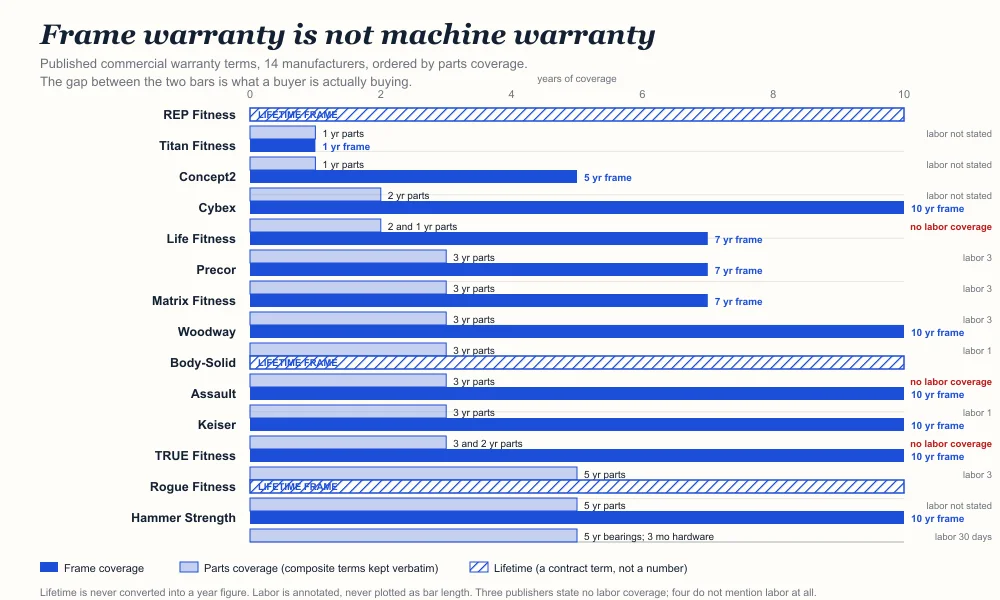
- Which parts are covered and which are not. Most schedules split the product into categories and put them on different clocks. Cables, pulleys, bearings, casters, upholstery and structural welds rarely share a term. A schedule that says “5 years” in the headline means very little until you find the exclusions.
- Who pays labour, and where. “Parts only” is the most common downgrade. “Parts only, in the country of purchase, for the original purchaser, non-transferable” is a normal clause; “lifetime frame” with everything else at 90 days is also a normal clause, and the two are not remotely comparable.
How to verify it: the schedule must be findable on the manufacturer’s own domain, not only in a PDF attached to your quote. If the manufacturer has a public warranty page, read it before you read the quote. We keep the published terms for equipment brands in their own records — for example the frame, parts, surface-finish and labour split is itemised separately for each product line in the Precor warranty PDF, and one brand’s headline “lifetime warranty” turns out to apply to exactly two components once you read the table.
The disqualifying answer: “we will send the warranty after delivery.” At that point you have no leverage.
2. The steel specification — and how to check it
Steel gauge is the single most-quoted and least-verified number in this industry.
- Ask for the gauge of the specific part, not “heavy duty steel” and not a gauge quoted for a different product in the same catalogue.
- Ask which standard it is measured against. Gauge without a thickness in millimetres is ambiguous.
- Weigh the part. This is the verification step almost nobody does, and it is the one that settles it. A fabricated upright has a mass. Put the quote, the catalogue drawing and a shipping scale in the same room and the gap between them is usually visible.
We hold no steel measurements of our own and we do not publish gauge figures for manufacturers who do not publish them themselves. When a brand’s own site never states a gauge, the honest position is that we do not know it — which is a different statement from a low gauge, and a much more common one than the marketing suggests.
3. The component list
Ask for a bill of materials for one flagship item, not a brochure. You want to know which cable, pulley, bearing, castor and upholstery supplier is fitted.
This is not pedantry. It determines three things you cannot discover later: whether you can source spares locally, whether a part you order will match the part already fitted, and whether the machine is serviceable at all once the supplier stops importing.
Watch for the substitution clause. Terms of sale from major manufacturers routinely permit component changes without notice. If that clause is present in your purchase contract, ask in writing what notice you receive and what your remedy is.
4. Tooling ownership and the end-of-relationship terms
If you are paying for custom colours, private labelling or a modified frame, you need to know three things in the contract:
- Who owns the tooling — you, the factory, or a third party.
- What happens to the tooling if you stop ordering.
- What happens to your product if the factory stops producing it, and whether you have any right to the last-buy quantities.
Custom work is where factory-direct sourcing is most attractive and most exposed. There is no distributor to fall back on, because the whole proposition was removing the distributor.
5. The minimum order quantity, the lead time, and who owns the delay
Get the lead time in writing, and find out what it is measured from. “45 days” is meaningless unless you know whether it starts at deposit, at drawing approval, at material availability or at port departure — these can differ by months in a year when steel moves.
Ask what the remedy is for a late delivery that pushes back an opening date. Most supply agreements provide a refund or a credit. Far fewer provide anything for the consequential cost of a delayed opening, which is the cost that actually hurts you.
6. The pre-shipment inspection protocol
Never skip it. The reason to insist is simple: after the container sails, the leverage you have is a claim, a photograph and a long conversation.
What a competent third-party inspection actually covers on fitness equipment:
- Quantity and model verification against the purchase order, including the correct finish and colour.
- Dimensional spot-checks on the items whose published specification you asked for in document 2.
- Weld and finish inspection on structural joints, with a stated pass criterion rather than “looks fine”.
- Functional sampling — cables, pulley travel, pin and clip retention, seat and pad adjustment under load.
- Photographic evidence with serial numbers, so the inspection report can be tied to the units that ship.
AQL-based sampling is not a substitute for the specification. An inspection tells you the batch matches the sample. It does not tell you the sample was right. That is what documents 2 and 3 are for.
Why a quoted price is not comparable until the warranty scope matches
This is where most factory-direct comparisons go wrong, and it is worth stating as plainly as possible.
Two quotes for the same-looking treadmill can differ by a wide margin and both be honest, because they are not quoting the same product. The variables that move the effective price, in rough order of how often they are the explanation:
| Variable | What it changes |
|---|---|
| Warranty scope | The difference between a structural term measured in years and one measured in months for the frame, and parts vs. labour |
| Warranty geography | Whether the warranty is honoured in the country the machine is installed in, by a local entity or by return-to-factory |
| Steel gauge and wall thickness | The heaviest single input in the frame |
| Moving components | Which cable, pulley and bearing brands are fitted, and whether spares exist |
| Powder coat and hardware | Often the largest single item after steel, and rarely specified numerically |
| Certification | Whether a test report exists for the model, and whether it names the model |
| Incoterm | What the quoted price includes, and where responsibility passes |
The practical consequence: a lower quoted price with a narrower warranty is not cheaper. It is a different purchase. You cannot compare the two until the warranty scope and the component list are aligned, and in most quotations those documents are the thing you have to ask for separately.
This is also why we publish warranty schedules brand by brand rather than a summary score. A summary number hides precisely the variable that decides the comparison. You can see how we handle it for commercial equipment warranties and for individual manufacturers in the brand directory.
The questions that reveal the most, in order
If you have time for a short call rather than a long document exchange, these are the questions whose answers separate suppliers fastest.
- Who is the warrantor in my country, and what is the entity name? A supplier who cannot answer this immediately is routing the question to someone else.
- Show me a document that states the warranty for one specific model, not a brand. The model-level schedule is the only version that binds.
- What is the steel gauge of the upright on the model I quoted, in millimetres? Watch whether the answer is a number or a return to the catalogue.
- What does “warranty” exclude, and who pays labour? Two questions, because the answers are often different.
- Can I have this in the contract? The answer matters more than the answer itself. Anything not in the contract is a hope.
On factory audits
We are often asked whether to visit the factory, and the honest answer is that a visit is worth it and is not sufficient.
Worth it: you will see the same production line that made your order, you can check whether the line is running the model you are buying or a different one, and a supplier that refuses a visit has told you something.
Not sufficient: a factory visit is a snapshot of the day you are there. It does not tell you whether the next run to the same order carries the same specification, and it does not tell you how the product will be handled by the people who service it, which in most markets is a different company.
If you want a second set of eyes, use an independent inspection firm that has no relationship with the supplier, and give them the specification documents as the acceptance criteria rather than the factory’s own checklist.
What we could not verify
Stated plainly, because a sourcing page that hides its gaps is worse than no page.
- We have never run a procurement audit for a client. Nobody at FitnessNav has done this work on anyone’s behalf, and we do not sell it as a service.
- We hold no venue operational data. No service-call rates, no failure intervals, no maintenance costs from any gym. If a page of ours gives you a number like that, it is not from us.
- We have not measured any manufacturer’s steel. Where we report a gauge, the manufacturer published it themselves and we say so. Where they do not, we write that we could not find it.
- We cannot tell you what a factory-direct purchase will save you. Not because the calculation is hard, but because we cannot verify the inputs, and an unverified cost model is a guess with a decimal point.
- Prices, lead times and MOQs change. Anything printed here about a specific commercial arrangement is out of date the day it ships. Verify against a current quotation.
Where to read the manufacturers’ own documents
Start with the source rather than with a summary:
- /brands/ — individual manufacturers, with the published terms we could actually locate for each
- /categories/equipment/ — the equipment register
- /insights/commercial-equipment-warranty-terms-comparison/ — the warranty schedules read side by side, each linked to the manufacturer’s own document
- /categories/wholesalers/ — the distribution layer this page is about the alternative to
If a manufacturer publishes a warranty schedule and a product specification, those two documents will answer most of the questions a buyer actually has. The expensive mistakes come from buying without them.
Correction notice
An earlier version of this page was titled as a case study and described a European fitness franchise that we never worked with. It attributed a three-month factory audit to the FitnessNav team, quoted distributor margins, and reported percentage reductions in purchase cost, service-call rate and three-year cost of ownership, together with a lifespan improvement attributed to a steel thickness change.
None of that was real. There was no client, no audit and no measurement. The previous version is the kind of page that reads as authoritative because it carries specific numbers, and the specific numbers were the problem.
It has been replaced with this checklist. The manufacturer named as the ODM partner in the previous version has been removed; we have no relationship with that company and should not have implied one.
If you saved or cited the earlier version, please disregard it. If you want to check this finding yourself, search this page’s slug in the Internet Archive.
Corrections to this page are welcome. Contact FitnessNav with the source document that contradicts anything written here.