What this comparison is, and what it is not
This page compares two manufacturers on what each of them publishes about itself. That is a narrow standard, and deliberately so.
We do not hold market-share data, dealer surveys, service-call records or equipment telemetry. We have not tested a single machine. Where a manufacturer makes a performance claim, we quote it as the manufacturer’s claim and say plainly that we cannot verify it. Where we could not locate a document at all, we say that too, rather than filling the gap.
An earlier version of this page did not work that way. It carried market-share figures, a revenue projection, an energy-consumption claim and an efficacy number presented as documented. Those are gone, and the correction notice records what was removed. The commercial effect is that this page is now less quotable and considerably more useful.
Technogym: what the company publishes
Biodrive and the Biostrength line
Biostrength is Technogym’s selectorized resistance line. The differentiator the company builds its current messaging around is Biodrive, described on its own product page as a patented, AI-driven electronic motor that alters resistance up to several thousand times per second. The stated consequence is that the machine can deliver training methods that a conventional motorised resistance stack cannot, and eccentric overload is named as the example.
The claim that gets repeated, and what we did to it. The same page states that Biostrength delivers 30% better results in the same time, and carries a section headed How does the Biodrive™ system actually deliver "+30% better results"? — the number appears in quotation marks in Technogym’s own copy.
That distinction matters more than it may look. A manufacturer quoting its own figure is making a marketing assertion. A manufacturer asserting a bare number as fact is making a stronger claim. Our earlier version of this page did the stronger thing on Technogym’s behalf, and described the gains as “documented” — a word that implies a provenance we cannot point to. There is no independent study on this comparison that we could locate, we have not run one, and the number should be read as positioning rather than measurement.
What is checkable here is the mechanism and the patent claim, not the percentage.
The rest of the published line
- Mywellness — the consumer-facing app layer, positioned as the user-facing side of the connected equipment.
- Checkup — a measurement station in the product range, oriented to assessments rather than to training.
- Goal Programs — training programmes offered within the equipment ecosystem, including the Tone and Strong programmes.
Financial reporting
Technogym publishes results, and we cite them with attribution rather than as our own analysis. The figures we were able to attribute to the company’s own reported period include nine-month revenue of €708.5M, up 14%, together with growth attributed to the Americas region and to the retail channel.
What the growth number does not establish. A regional growth rate is not evidence that a company is displacing competitors, and it is not a market-share measurement. An earlier version of this page drew that conclusion from the same figure. It does not follow.
What we could not find for Technogym
Stated plainly, because these are the gaps a buyer is most likely to trip over:
- No consolidated warranty schedule we could locate. Technogym publishes warranty information by region and product through its sales organisation, but we could not find a single document itemising parts, labour and exclusions per model. Ask your regional office for it in writing before you sign — that request is the test.
- No primary document for the Olympic supply figures. Earlier versions of this page carried specific unit and athlete counts for the Milano Cortina 2026 Winter Games and a forward revenue projection. Every press and news path we tried resolved to the same generic product landing page with no mention of the event. We could not locate a primary document, so we have removed the figures rather than restate them unverified.
- No independent efficacy data on the resistance technology.
Life Fitness: what the company publishes
Symbio and the Red Dot Award
Life Fitness states on its own Symbio product page that the series “has been rewarded with the prestigious Red Dot Award 2024”, and describes it as built around world-first patented and patent-pending technologies, positioned around “a natural, sensory workout experience.”
A correction worth stating plainly: an earlier version of this page recorded the Red Dot award as 2025. The company’s own page says 2024. We had the number wrong while quoting the manufacturer, which is the exact failure mode this page is meant to eliminate.
Connect System and the integration position
Life Fitness positions Connect System as an open platform, with a published API and named partner relationships. The direction of travel is toward third-party interoperability rather than a closed ecosystem.
On integration counts: an earlier version of this page stated that the platform integrates with over one hundred third-party apps and wearables. We could not locate a published count, so it has been removed. If integration is decisive for your club, the useful question is not “how many” but “which ones, at which software version, under what commercial terms” — and that list should come from the vendor in writing.
Warranty terms
Life Fitness publishes warranty information split by equipment type, with separate pages for strength and for cardio and strength service terms. The published schedules are itemised per product line rather than summarised, which makes them comparable — the detail that matters when you are trying to work out what a machine is worth in year three.
We link the manufacturer’s own document rather than reproducing its terms here, because warranty schedules change and a copied table is a table that goes stale.
What we could not find for Life Fitness
- No published market-share figure, and we did not find one to cite. An earlier version of this page asserted a share of the North American commercial market. That number came from nowhere we could trace and has been removed.
- No published service-response commitment in the material we reviewed. This is the variable we would most want to see, and its absence is worth raising with the vendor.
Where the comparison actually resolves
Two manufacturers, two different ways of publishing. This is the useful part.
| Technogym | Life Fitness | |
|---|---|---|
| Where the differentiation sits | Motor technology — Biodrive, described as patented and altering resistance thousands of times per second | Console and platform design — Symbio positioned around sensory experience and an open integration layer |
| Documented third-party recognition | None located in the material we reviewed | Red Dot Award 2024, stated on the product page |
| Quantified performance claim | Yes — the manufacturer states 30% better results and puts the number in its own quotation marks. No independent verification located | None found |
| Published warranty document | Not located as a single consolidated schedule — obtained through regional sales | Published, split by equipment type, itemised per product line |
| Integration position | Mywellness app and connected line; no published integration count located | Connect System, published API and named partners; no published integration count located |
| Financial disclosure | Publishes results; cited with attribution above | Private; we do not report financial strength figures we cannot source |
The honest reading. Technogym’s differentiation is engineering-led and comes with a striking headline number that the manufacturer itself hedges. Life Fitness’s differentiation is design-led, carries a dated third-party design award, and publishes its warranty terms in a form you can actually compare. Those are the two things a procurement decision can rest on: a number you have to take on trust, versus a document you can read.
Neither of those tells you who services the machine when it fails in your country. That is the question to put to both, in writing, before the purchase order — along with the warranty schedule each of them gives you, and the exclusions inside it.
What we could not verify
- Any market-share figure, for either company. We have none and found none to cite.
- Any independent efficacy data for the resistance technology. The performance number is manufacturer-stated.
- Any third-party service or failure data. We hold no service-call records and have tested nothing.
- User sentiment. We have no review corpus, no survey panel and no forum dataset. Comparisons built on “what operators say” are not something we can do.
- Equipment pricing and margin. Not published by either manufacturer in a form we can cite, and not something we estimate.
- Technogym’s consolidated warranty schedule, and Life Fitness’s published service-response commitment.
Correction notice: this page was rewritten 2026-10-06
An earlier version of this page compared Technogym and Life Fitness using figures we could not source. Removed:
- Market-share figures for both manufacturers, including a stated share of the North American commercial market attributed to a partnership narrative.
- A forward revenue projection presented as an estimate, and unit and athlete counts for an Olympic event for which we could not locate a primary document.
- An efficacy number presented as documented. The figure originated with the manufacturer and appears in the manufacturer’s own copy in quotation marks; our earlier phrasing asserted it as independent fact and used the word “documented”, which was false.
- An energy-consumption claim for one manufacturer’s motor, with no source. We cannot measure energy use and should not have implied that we could.
- A named award with the wrong year. Red Dot is 2024, per the manufacturer’s own page. We had written 2025.
- User-sentiment characterisations for both companies, with no data source behind them.
- An integration count we could not locate a published figure for.
- Superlative conclusions — that one manufacturer “wins” named sectors, or is the “undisputed” or “premier” choice — which no document supports.
- A duplicate FAQ entry in which one question about an Olympic event appeared twice with different answers.
The rewrite keeps the comparison but changes its basis: primary documents, quoted as their owners wrote them, with the gaps stated. If you find a claim here you cannot trace to a document, that is a defect — contact FitnessNav.
Related Intelligence
- Technogym vs Life Fitness vs Precor vs Matrix — four manufacturers compared on published warranty terms
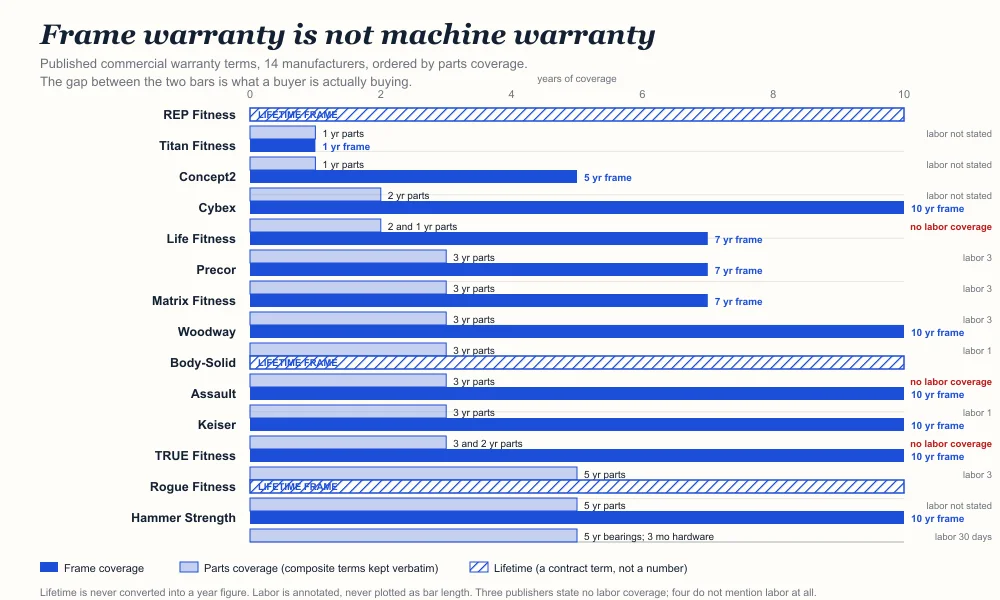
- Commercial Equipment Warranty Terms Compared — fourteen manufacturers’ schedules, line by line, each linked to the manufacturer’s own document
- Top Commercial Fitness Equipment Manufacturers 2026 — the manufacturer layer
- Technogym · Life Fitness · Precor
- How we score brands — the six-dimension method used on our brand pages, which is a different instrument from this comparison
Methodology note: this comparison is documentary. Every claim is either published by the manufacturer and quoted as they published it, attributed to a named third party, or recorded as unverified. Where a manufacturer-reported figure appears, it is labelled as manufacturer-reported and has not been independently audited by us. We do not operate facilities, have not tested equipment, and hold no service, failure or market-share data. Reliability varies with utilisation, maintenance compliance and environment.*