Key Takeaways
-
Biomechanical Differentiation: Curved non-motorized treadmills are specialized posterior-chain conditioning tools, and the metabolic premium is real and measured — but it is smaller and more variable than the fitness industry usually claims. In the largest peer-reviewed comparison we could locate, running energy cost on a curved non-motorized deck was 17% higher than on a motorized belt at matched speed; in a separate study, oxygen uptake ran about 32% higher with heart rate 17% higher and cadence about 2.6% higher. Both are cited below with their sample sizes. An earlier version of this page printed a table of metabolic and EMG percentages attributed to unnamed “clinical studies”; those figures have been removed, and two of them turned out to be real studies’ numbers carrying the wrong labels.
-
Slat Chemistry Matters: The single most important durability differentiator is slat material. Woodway Curve uses vulcanized rubber slats rated for 150,000 miles; AssaultRunner Pro uses a non-slip composite slat. This directly impacts long-term maintenance costs and belt replacement frequency.
-
Total Cost of Ownership Divergence: While the AssaultRunner Pro ($2,999) carries less than half the list price of the Woodway Curve ($6,995), that gap is almost entirely acquisition cost. On the five-year model in Chapter 5 the Pro lands roughly $3,100 ahead, and we put no resale credit in the model at all.
-
Target Environment Specialization: Woodway Curve excels in athletic performance facilities requiring research-grade gait analysis (Curve 3.0) and consistent belt response. AssaultRunner dominates the CrossFit and HIIT segment where extreme acceleration/deceleration cycles and lower upfront CapEx are the primary purchase drivers.
-
Infrastructure Requirements: Both are self-propelled with near-zero electrical consumption, eliminating the need for dedicated circuits. However, the Woodway Curve (355 lbs) requires a heavier structural footprint than the AssaultRunner Pro (280 lbs).
Chapter 1: Biomechanical Kinematics — How Curvature Profiles Drive Performance
The defining characteristic of manual curved treadmills is their replacement of the motor with a curved running surface. The runner must supply all energy to rotate the belt, which fundamentally alters gait mechanics compared to motorized flat treadmills.
What the published research actually measured
There is a peer-reviewed literature on curved non-motorized treadmills (cNMT), and an earlier version of this page summarised it badly — it attributed figures to unnamed “clinical studies” and “peer-reviewed kinematic studies published in the Journal of Sports Sciences”. We have now gone back to the papers themselves. Two of the numbers we printed turned out to be real results carrying the wrong labels, which is worse than inventing them, because they look checkable. Here is what the sources actually say.
Schoenmakers & Reed (2018) ran 9 participants at four velocities on a cNMT and a motorized treadmill. Relative to the motorized condition, cNMT running produced +32.5 ± 5% relative VO₂max, +16.8 ± 3% heart rate, +2.6 ± 0.7% cadence and +27.2 ± 5% rating of perceived exertion, all p < 0.001. Their most decision-relevant finding is not a percentage at all: on the curved deck, 90% VO₂max was reached at 62.1 ± 3.5% of maximum speed, against 81.4 ± 5.6% on the motorized belt. The practical translation is that a given session on a curved machine is a materially harder workout, so the speed on the console is not comparable to the speed on a motorized one.
A second study in the Journal of Sports Sciences (2019;37(4):396–403, doi 10.1080/02640414.2018.1504605) measured 25 volunteers and found the energy cost of running 17% higher on the curved deck, with maximal running speed lower (3.75 ± 0.39 vs 4.31 ± 0.50 m·s⁻¹). It found no major kinematic differences at paired submaximal speeds, and attributed the cost difference to belt characteristics — friction, surface type and curvature — rather than to the runner’s mechanics.
On the “a curved deck fixes your gait” claim, the evidence runs the other way. A 2024 Journal of Sports Sciences analysis concluded that running on curved non-motorized treadmills is more biomechanically different from overground running than motorized treadmills are, and is therefore “not the best strategy to replicate overground running in terms of joint kinematics during highly controlled research studies”. That matters for a facility: these machines are a conditioning tool, not a gait-analysis surrogate, and no Woodway or Assault product in this comparison sells one that turns them into a gait laboratory.
What we removed, and why
The previous version of this section carried a table reading Oxygen Consumption +37%, Heart Rate +22%, Energy Expenditure +30% to +44%, attributed to “clinical studies” with no citation, alongside a claim of “10% to 30% more cardiovascular effort” in the sentence immediately above it. Two of those numbers trace to real papers and are attached to the wrong variables: the +37% is the walking energy-cost difference from the 2019 study, not the running oxygen figure, and the +22% heart-rate figure belongs to a study that reported 16.8%. The remaining figures trace to nothing we could locate. An earlier version also claimed that EMG studies show 18–22% greater hamstring activation on a curved manual treadmill; we searched and found no study making that comparison, so the number is gone rather than softened.
| Metabolic / perceptual metric | Source | What it actually reports |
|---|---|---|
| Relative VO₂max, running | Schoenmakers & Reed, 2018 (n=9) | +32.5 ± 5% on cNMT |
| Heart rate, running | Schoenmakers & Reed, 2018 | +16.8 ± 3% |
| Step cadence, running | Schoenmakers & Reed, 2018 | +2.6 ± 0.7% |
| Rating of perceived exertion | Schoenmakers & Reed, 2018 | +27.2 ± 5% |
| Speed at 90% VO₂max | Schoenmakers & Reed, 2018 | 62.1 ± 3.5% Vmax (cNMT) vs 81.4 ± 5.6% (motorized) |
| Energy cost, running | J Sports Sci 2019;37(4):396–403 (n=25) | +17% on cNMT |
| Energy cost, walking | same study | +37% on cNMT |
| Maximal running speed | same study | 3.75 ± 0.39 vs 4.31 ± 0.50 m·s⁻¹ |
| Ground contact time | — | not measured by any source we located |
Two caveats belong with that table. All of these are laboratory studies on small samples — 9 and 25 participants, mostly on specific curved models — not on the Woodway Curve or the AssaultRunner specifically, and none of them measures a Woodway-versus-Assault difference. Our sample of nine to twenty-five runners cannot tell you which of these two brands produces a better metabolic response.
Posterior Chain Muscle Recruitment
Because the runner must actively pull the belt downward and backward with each step, manual curved treadmills recruit the posterior chain differently from a motorized belt. We cannot put a number on it. The studies that measure muscle activation in this area compare treadmill running against overground running or vary treadmill grade — not curved deck against flat motorized deck — so the direction of the effect is a reasonable inference from the mechanical requirement, while any percentage would be ours rather than a source’s. If this specific question matters to your programme, the honest route is to measure it: surface EMG on your own users, reported as your measurement with the model, the speed and the sample size attached.
The Woodway Curve (5% curve) has a shallower, more graduated curvature transition. The AssaultRunner (9-degree front curve) presents a steeper front engagement zone. Both descriptions are taken from the manufacturers’ own published specifications. Neither manufacturer publishes the physiological response of its own machine, so no claim on this page ranks one brand’s “gait quality” above the other’s.
Chapter 2: Brand Deep-Dive — Woodway Curve vs AssaultRunner
For a broader overview of the entire premium slat-belt market including motorized platforms and connected treadmills, see our companion Premium Slat-Belt Treadmill Comparison. This chapter provides focused profiles on the leading curved manual brands.
2.1 Woodway Curve (Standard, Curve 1.5, and Curve 3.0)
Design Philosophy: Built to withstand heavy use in athletic training and commercial environments. The 5% curve allows rapid acceleration without speed limits.
Mechanical Structure: 60 individual vulcanized rubber slats riding on 112 precision ball bearings with 12 roller guides. Lateral movement is limited to under 4 mm through precision track alignment.
Slat Chemistry — Vulcanized Rubber: This is the defining engineering advantage of the Woodway platform. Vulcanized rubber offers superior abrasion resistance, maintains traction integrity across temperature and humidity variations, and is rated for up to 150,000 miles before replacement. The rubber compound (manufactured by Kraiburg for premium models) provides consistent friction coefficient over the belt’s entire service life.
Target Environment: High-performance athletic facilities, collegiate training rooms, commercial functional fitness zones.
Pricing (2025–2026):
- Woodway Curve (standard): MSRP $6,995, street pricing ~$5,999
- Curve 1.5 upgrade: Adds user stats tracking, Excel/PDF export, unique user logins — approximately $1,500–$2,000
- Curve 3.0 upgrade: Adds dynamic force plates and pacer software for research-grade gait analysis and bilateral strike measurement — approximately $4,500 premium over base
Key Strengths:
- Exceptional durability (150,000-mile slat lifespan)
- Predictable, consistent belt response — minimal resistance variation
- Research-grade gait analysis capability (Curve 3.0)
- Low maintenance — factory-sealed bearings require no lubrication
Limitations:
- High initial cost (starting at $6,995)
- Simple console options on base model
- Heavy footprint (355 lbs) — requires structural floor verification
- Does not fold
2.2 Woodway Curve LTG
Design Philosophy: A more compact, accessible manual curved treadmill for light commercial and premium residential settings.
Mechanical Structure: 60 thermoplastic elastomer (TPE) slats with a gentler 3% curvature. The reduced curve angle makes it easier to maintain steady pace during recovery walks and endurance runs.
Pricing: $3,995
Key Strengths:
- Lighter frame (297 lbs vs. 355 lbs on standard Curve)
- Lower entry price for a Woodway asset
- Gentler 3% curvature suitable for mixed walk/run usage
Limitations:
- TPE belt lacks the premium feel and durability of vulcanized rubber
- Reduced weight capacity (350 lbs for running)
- Cannot be upgraded to Curve 3.0 gait analysis
2.3 AssaultRunner Pro
Design Philosophy: Industry standard for CrossFit and high-intensity interval training. The AssaultRunner Pro was designed specifically for the extreme acceleration/deceleration cycles characteristic of functional fitness workouts.
Mechanical Structure: 9-degree front curve with 17.1-inch wide belt. Self-propelled with 350 lbs user weight capacity. The belt uses a non-slip composite slat system mounted on a steel frame.
Pricing: Approximately $2,999 (often bundled in CrossFit gym packages)
Key Strengths:
- Affordable entry point — less than half the cost of Woodway Curve
- 7-year frame term — Assault’s published grading is Classic 5 years, Pro 7 years, Elite 10 years
- Proven durability in extreme-condition settings (thousands of CrossFit affiliates)
Limitations:
- Heavier initial belt resistance — users require adaptation period
- No incline or resistance variation capability
- Basic LCD console with limited metrics
- Composite slat system has shorter effective lifespan than vulcanized rubber
- The published policy does not commit to supplying parts for discontinued models
2.4 AssaultRunner Elite
Design Philosophy: Upgraded version of the AssaultRunner platform with enhanced durability, comfort, and extended warranty terms.
Mechanical Structure: Same chassis as the Pro with reinforced upright structure, solid steel handrails, and premium UV-resistant console screen.
Pricing: Approximately $3,895
Key Strengths:
- 10-year frame warranty — the top of Assault’s published frame grading
- 3-year mechanical parts, 1-year console, 1-year labor
- 400 lbs user weight capacity
- Storage compartments
Limitations:
- Identical belt dynamics and biomechanical feel to the Pro despite the higher price point
- Same composite slat chemistry as the Pro — no durability upgrade
Chapter 3: Head-to-Head Technical Specifications
| Dimension / Feature | Woodway Curve | Woodway Curve LTG | AssaultRunner Pro | AssaultRunner Elite | TrueForm Runner | TrueForm Trainer |
|---|---|---|---|---|---|---|
| Class | Manual Curved | Manual Curved | Manual Curved | Manual Curved | Manual Curved | Manual Curved |
| Curvature Profile | ~5% gradient | ~3% gradient | 9-degree front | 9-degree front | Shallow 2–3% | Shallow 2–3% |
| Running Surface | 17” x 67” | 17” x 62” | 17.1” x 62.2” | 17.1” x 62.2” | 17” x 64” | 17” x 54” |
| Unit Weight | 355 lbs | 297 lbs | 280 lbs | 289 lbs | 340 lbs | 270 lbs |
| Weight Capacity (Run) | 400 lbs | 350 lbs | 350 lbs | 400 lbs | 400 lbs | 400 lbs |
| Slat Chemistry | Vulcanized Rubber | TPE | Non-slip Composite | Non-slip Composite | Kraiburg Thermolast | TPE |
| Precision Bearings | 112 ball bearings + 12 roller guides | 112 ball bearings | Standard bearing track | Standard bearing track | 112 sealed steel bearings | Standard bearing track |
| Max Speed | Unlimited | Unlimited | Unlimited (20 mph cap) | Unlimited (20 mph cap) | Unlimited | Unlimited |
| Console Options | Base / 1.5 / 3.0 Gait | Basic LCD | Basic LCD | UV-resistant LCD | Basic LED | Basic LED |
| Belt Lifespan | 150,000 miles | 80,000–100,000 miles | Not stated in source | Not stated in source | 100,000+ miles | 80,000–100,000 miles |
| MSRP | $6,995 | $3,995 | $2,999 | $3,895 | $6,845 | $2,995 |
Chapter 4: Slat Chemistry and Durability — The Critical Differentiator
The single most important operational differentiator between Woodway Curve and AssaultRunner is their slat chemistry, as this determines maintenance frequency, replacement cost, and long-term Total Cost of Ownership.
Vulcanized Rubber (Woodway Curve)
Vulcanized rubber is produced through a chemical process that cross-links polymer chains with sulfur or other accelerators, creating a durable elastomer with superior abrasion resistance and elastic recovery. The Woodway Curve’s slats are molded from this material and mounted on individual aluminum carriers riding on precision ball bearings.
- Mileage rating: 150,000 miles before replacement
- Warranty treatment: The published structure names the belt explicitly — drive, belt and motor 5 years, against a 10-year frame term and 3 years on remaining parts
- Traction stability: Consistent coefficient of friction across temperature range (40°F–120°F)
- Wear pattern: Gradual, predictable surface wear with no sudden failure mode
- Replacement cost: High — slats are replaced individually rather than as an assembly. Woodway publishes no per-slat price, so any figure you encounter is a dealer quote to confirm, not a published price
- Environmental tolerance: Resistant to humidity, sweat corrosion, and UV degradation
Thermoplastic Elastomer (Woodway Curve LTG)
TPE is a polymer blend that combines rubber-like elasticity with thermoplastic processability. While lighter and more cost-effective than vulcanized rubber, TPE has lower abrasion resistance and a shorter service life.
- Mileage rating: 80,000–100,000 miles
- Traction stability: Moderate degradation over time; surface becomes smoother with wear
- Replacement cost: Moderate
- Best use case: Light commercial, residential, low-to-moderate traffic environments
Non-Slip Composite (AssaultRunner Pro/Elite)
AssaultRunner uses a proprietary non-slip composite material for its slats. The material provides excellent initial traction and is optimized for the high-torque, sudden-acceleration demands of CrossFit-style training.
- Mileage rating: Not published. The warranty structure does not assign a mileage figure to the composite slat, and it does not enumerate the belt as a separately warranted component
- Traction stability: Excellent initial grip; surface smooths with extended use
- Wear pattern: More variable than vulcanized rubber — influenced by training style and cleaning frequency
- Replacement cost: Lower than a vulcanized rubber slat set. The published policy states no replacement price and no parts-supply commitment for discontinued models
- Environmental tolerance: UV-resistant on Elite model; standard model may show sun degradation in outdoor-adjacent installations
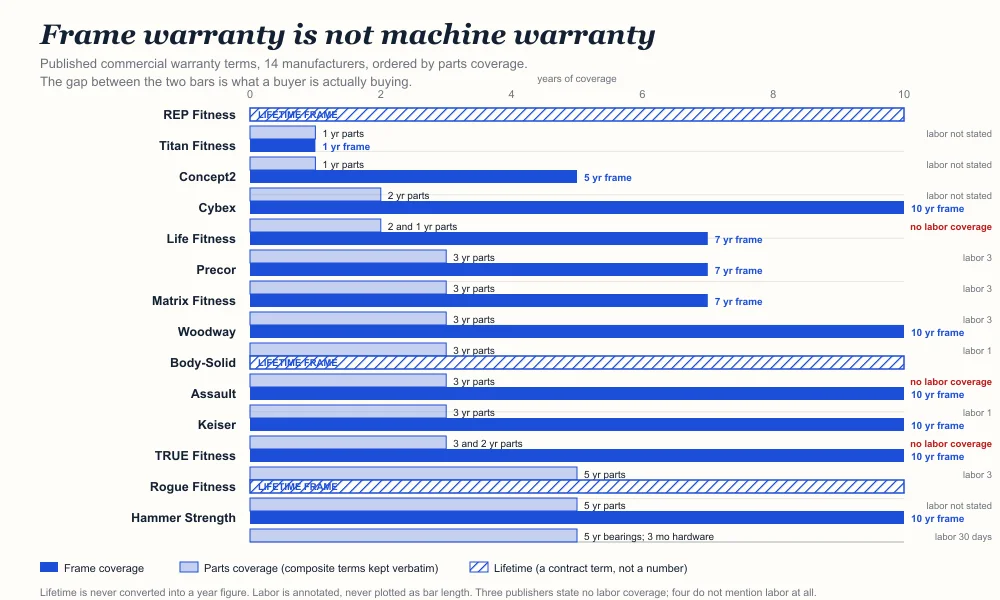
Neither manufacturer publishes a lifetime term for the running surface in the documents we verified, and both grade the belt inside a parts bucket rather than warranting it as its own component. Woodway’s published structure is frame 10 years, drive/belt/motor 5 years, remaining parts 3 years, labor 1 year. Assault’s Elite structure is frame 10 years, mechanical parts 3 years, console 1 year, labor 1 year; the Pro sits one grade down at a 7-year frame term. Both sets of terms are recorded in Commercial Gym Equipment Warranties. Two caveats belong with those numbers: Woodway’s document is an owners manual at a 2013 revision, so the terms may have been superseded, and Assault’s terms appear in a policy PDF shared with Precor rather than on an Assault-branded page. Confirm both with the dealer before treating either as contractual.
Chapter 5: Strategic Total Cost of Ownership (TCO) Analysis
Evaluating curved treadmill assets requires looking beyond the initial purchase price. The standard formula for Total Cost of Ownership over a 10-year operational life:
Where:
- \(C_{purchase}\) = Initial capital expenditure (CapEx)
- \(O_{t}\) = Annual operating costs in year \(t\) (negligible for self-propelled units)
- \(M_{t}\) = Annual maintenance, parts, and labor in year \(t\)
- \(S_{t}\) = Salvage/resale value at end of useful life
- \(r\) = Annual discount rate (assume 5%)
- \(n\) = Operational lifespan in years
5-Year Cost Model (High-Volume Commercial — 8 hours/day)
| Cost Component | Woodway Curve | Woodway Curve LTG | AssaultRunner Pro | AssaultRunner Elite |
|---|---|---|---|---|
| Acquisition Cost (published MSRP) | $6,995 | $3,995 | $2,999 | $3,895 |
| Annual Electricity | ~$5 (console only) | ~$5 (console only) | ~$5 (console only) | ~$5 (console only) |
| Year 1–5 Maintenance | Slat alignment check ($100/yr) | Slat alignment + TPE inspection ($150/yr) | Belt tension + bearing check ($200/yr) | Belt tension + bearing check ($200/yr) |
| Projected Mid-Life Running-Surface Service | None modelled | ~$800 (year 5) | ~$400 (year 3–4) | ~$400 (year 4–5) |
| Resale Credit at Year 5 | Not modelled | Not modelled | Not modelled | Not modelled |
| Cumulative 5-Year Cost | ~$7,520 | ~$5,570 | ~$4,424 | ~$5,320 |
Read the inputs before you read the totals. Acquisition is the only documented row in this table — published list price. Electricity is negligible because both machines are self-propelled. The maintenance and mid-life service rows are our own placeholders: none of the manufacturers in this comparison publishes a service price or a costed maintenance schedule, and we hold no dealer quotes. Every total is therefore the plain arithmetic sum of the five inputs above, undiscounted, with the salvage term set to zero. Substitute your own quotes and the ordering survives, because the spread between the highest and lowest maintenance assumption in this table is $500 across five years, against a $3,996 spread in list price.
Key TCO Insights
-
The LTG buys its way to a lower five-year cost. At $3,995 against $6,995, the LTG’s cumulative five-year cost sits about $1,950 below the standard Curve even after its year-5 slat service. Treat that as a buying decision rather than a lifecycle verdict — the advantage starts eroding after year five, which this model does not cover, and the standard Curve’s running surface is the only one in this comparison carrying a manufacturer mileage rating.
-
The AssaultRunner Pro wins on the five-year horizon. Its $2,999 list price puts it about $3,096 below the Woodway Curve’s cumulative five-year cost. For facilities on a 3–5 year equipment rotation cycle, or that amortize equipment aggressively, that gap decides the purchase on its own.
-
The Woodway Curve suits high-volume permanent installations. Woodway rates its vulcanized rubber slats at 150,000 miles. That is the manufacturer’s figure, not our measurement, and we have not tested it. If it holds in your facility, you avoid the mid-life running-surface service the composite slats require — which is a reason to check your own hours-run log against that number, not a reason to take our word for it.
-
Resale is a real question, and we deliberately leave it unpriced. The factors a buyer can actually verify are set out in the next section. The percentage is not, because we have no transaction data behind one.
Why we publish a resale method and not a resale number
A year-five resale value is the most quotable number in a comparison like this one, and it is the one we cannot source. Putting a figure on it would need a dataset we do not have: actual transaction prices, hours-run per unit, condition grading, and regional demand. FitnessNav does not trade in used equipment and holds no fleet disposal records, so any percentage we printed would be an invention wearing a decimal point. Our published reasoning for this is set out in How we score brands.
What the documents can tell you is what a buyer inherits at resale, and on both counts these two differ in documented ways:
- Transferability. Woodway’s published commercial warranty is non-transferable. Assault’s published policy requires a transfer letter and does not state the effect on resale. A non-transferable term expires at the point of sale, which is the one part of resale risk a buyer can price.
- Parts support past the term. Woodway names drive, belt and motor inside a 5-year bucket. Assault’s published Elite structure is frame 10 years, mechanical parts 3 years, console 1 year, with no separately named belt coverage — so a buyer outside the original term depends on a parts supply the policy does not commit to. Both structures are recorded in Commercial Gym Equipment Warranties.
Chapter 6: Procurement Decision Framework
Facility Fitment Assessment
Step 1: Verify Floor Load Limits
The building engineer must confirm static and dynamic load capacity, especially for upper-level installations. The Woodway Curve (355 lbs) imposes a higher static load than the AssaultRunner Pro (280 lbs). We do not publish a pounds-per-square-foot figure: no manufacturer in this comparison publishes a floor-load rating, and an earlier version of this page gave one — 150 lbs/sq ft — that we could not trace to a document. That number is exactly the kind of figure a structural engineer must not take from a comparison article, so we have left the calculation to them.
Step 2: Clearance Zones
Both manufacturers publish an installation footprint for these units. Follow the manual’s clearance figures for the specific model. We are not quoting a clearance dimension here because we could not confirm one figure per model, and a generic “6 ft behind, 3 ft each side” applied to the wrong model is how a unit ends up against a wall that should not have it.
Step 3: Electrical
Both are self-propelled and draw no power to move the belt; the console is the only electrical load. Battery life for the console is not something either manufacturer states in the documents we read, so treat any replacement interval you are told as indicative and check it against your own usage.
Decision Tree: Woodway Curve vs AssaultRunner
Is your primary training modality HIIT and functional fitness?
   |
   +---> Yes
   |        |
   |        +---> Budget under $3,500? ---> Buy AssaultRunner Pro
   |        +---> Budget $3,500–$4,000? ---> Buy AssaultRunner Elite
   |        +---> Need advanced analytics? ---> Buy Woodway Curve (different use case)
   |
   +---> No (Athletic performance / gait correction / steady-state training)
            |
            +---> Budget under $4,000? ---> Buy Woodway Curve LTG
            +---> Budget $4,000–$7,000?
            |        |
            |        +---> Need gait analysis? ---> Buy Woodway Curve + 1.5/3.0 upgrade
            |        +---> Premium build priority ---> Buy TrueForm Runner
            |
            +---> Need research-grade biomechanics? ---> Buy Woodway Curve 3.0
Procurement Decision Matrix
| Criterion | Weight | Woodway Curve | AssaultRunner Pro | AssaultRunner Elite | Scoring Rule |
|---|---|---|---|---|---|
| CapEx Efficiency | 20% | 5/10 | 10/10 | 7/10 | 10 under $3,000 list; 7 for $3,000–$4,000; 5 for $5,000–$7,000 |
| Slat Durability | 25% | 10/10 | 6/10 | 6/10 | 10 for a published rating of 150,000 miles or more; 6 where the manufacturer publishes no mileage rating for the running surface |
| Gait Analytics | 15% | 9/10 (w/ 3.0) | 3/10 | 3/10 | 10 for research-grade tools |
| HIIT Suitability | 20% | 7/10 | 9/10 | 9/10 | 10 for CrossFit-optimized |
| Published Warranty Structure | 10% | 10/10 | 4/10 | 6/10 | 10 for a 10-year frame term with the drive/belt system named in a parts bucket of 5 years or more; 6 for a 10-year frame term with 3-year parts and no named belt coverage; 4 for a 7-year frame term |
| Maintenance Burden | 10% | 9/10 | 7/10 | 7/10 | 10 where no mid-life running-surface service falls inside year 5; 7 otherwise |
| Weighted Score | 100% | 8.15/10 | 6.85/10 | 6.45/10 | Weighted sum |
The weighted scores are an editorial ranking against the rules in the right-hand column, not a validated model, and FitnessNav’s published six-dimension brand scoring is not applied here. Published Warranty Structure is the only row scored straight from primary documents; the rest is our assessment of the specifications tabulated in Chapter 3. Every rule is stated so you can dispute a score by pointing at the rule rather than at our judgment — and if your hours-run profile or your holding period differs from the five-year window in Chapter 5, rescore it rather than reuse it.
Chapter 7: Operational Checklists and Commissioning
Pre-Installation Verification
- Floor Capacity Audit: Ask the building engineer for the required dynamic load rating for the specific model and location. No figure is published on this page — see Step 1 above.
- Clearance Zones: Confirm against the manual for the specific model
- Climate Control: Your facilities team decides this; we publish no humidity range as a manufacturer requirement
- Level Floor: Confirm the manual’s stated tolerance during commissioning
Post-Delivery Commissioning
- Belt Track Alignment: Manually rotate belt; verify slats run parallel with lateral clearance under 4 mm (Woodway) or within manufacturer spec (AssaultRunner)
- Bearing Inspection: All precision bearings spin smoothly with no rattling
- Under-Deck Clearance: No debris under deck that could interfere with belt rotation
- Console Test: Verify display readings and connectivity
- User Walk Test: Walk at slow pace to confirm smooth belt rotation
Maintenance Schedule
| Frequency | Woodway Curve | AssaultRunner |
|---|---|---|
| Weekly | Wipe slats with damp cloth | Wipe slats with damp cloth |
| Monthly | Vacuum under and around unit | Vacuum under and around unit; check belt tension |
| Quarterly | Inspect bearing track for debris | Inspect bearing track; lubricate if needed |
| Semi-Annual | Check structural bolts | Check structural bolts; inspect slat wear pattern |
| Annual | Full alignment check | Full bearing inspection |
Frequently Asked Questions
Which curved treadmill is better for a CrossFit gym?
The AssaultRunner Pro is the cheaper machine by a wide margin — $2,999 against $6,995 at published list price — and it is widely installed in functional-fitness and CrossFit-affiliated gyms. We hold no installation census, so we will not tell you it is “the industry standard”, and we removed that claim from an earlier version of this page. Its 9-degree front curve presents a steeper initial engagement, which is a design argument for interval work rather than a measured one.
Which curved treadmill lasts longer?
We cannot answer this, and the honest reason is specific: Woodway publishes a mileage rating for its running surface and Assault does not publish one for its own slat, which is why Chapter 4 rates the AssaultRunner as “Not published” rather than low. That is an asymmetry in disclosure, not a measurement of durability. Woodway’s figure of 150,000 miles is the manufacturer’s own figure and not something we have tested. An earlier version of this answer also asserted service-life windows of “7–10 years” for a Woodway and “belt attention at year 4–5” for an Assault; we could not source either, so they are gone. What you can do instead is check the rating against your own hours-run log, and get a written service quote for the year you expect to need it.
Can I do gait analysis on an AssaultRunner?
The AssaultRunner’s basic LCD console provides speed, distance, time, and calories only. It does not support gait analysis. For research-grade biomechanical data including bilateral force measurement and gait phase tracking, the Woodway Curve with the 3.0 upgrade is the only option in this comparison.
Do curved treadmills require electricity?
No. Both Woodway Curve and AssaultRunner are self-propelled (non-motorized). They consume zero grid electricity during operation. The consoles run on battery power (typically AA or rechargeable), requiring minimal periodic battery replacement.
Is the AssaultRunner Elite worth the upgrade over the Pro?
The Elite ($3,895 vs. $2,999) adds reinforced uprights, a premium UV-resistant console, 400 lbs weight capacity (vs. 350 lbs), and a 10-year frame warranty. The belt dynamics and biomechanical feel are identical. The Elite is worth the premium only if you need the higher weight capacity or are placing the unit in a sunny/lit location where UV resistance matters.
What is the true cost difference over 5 years?
On the five-year model in Chapter 5 — published list price, our own placeholder maintenance inputs, and no resale credit — the AssaultRunner Pro lands at roughly $4,420 against the Woodway Curve’s $7,520, about 41% lower. That is a model, not a measured outcome: the acquisition inputs are published prices, while the maintenance and service figures are placeholders we chose. The Woodway Curve’s case appears later, where the composite slat on the AssaultRunner needs mid-life service and Woodway’s vulcanized rubber may not. Whether that happens, and when, is exactly what neither manufacturer publishes.
Related Intelligence
Extend your procurement research with these complementary FitnessNav Intelligence reports:
- Premium Slat-Belt Treadmill Comparison: Woodway vs Assault Runner vs TrueForm vs Technogym — Full-market overview including motorized slat-belt platforms and connected consumer treadmills.
- Commercial Fitness Equipment Performance Report: 2026 Edition — Benchmarks on equipment durability, maintenance costs, and lifecycle analysis across all commercial cardio categories.
- How we score brands — the scoring framework FitnessNav publishes, which is not applied in this report.
- Fitness Equipment Investment Strategy Report: 2026 — Capital allocation framework for fitness asset procurement across multiple equipment classes.
What This Means For You
For Commercial Gym Operators
The decision turns on your training demographics and your holding period. If members do steady-state work, recovery walks or long efforts, note that a curved deck reaches 90% VO₂max at a markedly lower percentage of maximum speed than a motorized belt — 62% against 81% in the study cited in Chapter 1 — so interval prescriptions and member-facing speed targets do not transfer between the two machine types. If your facility is functional-fitness or HIIT-dominated, the $3,996 list-price gap decides the purchase on its own, and the five-year model in Chapter 5 shows the gap surviving that horizon under our stated placeholder assumptions.
For Athletic Performance Directors
The Woodway Curve 3.0 adds dynamic force plates and pacer software to the platform; the AssaultRunner consoles in this comparison do not offer that class of measurement. If objective bilateral strike measurement is a requirement, that is a documented specification difference. Be aware of what it is not: the 2024 analysis cited in Chapter 1 found curved decks move further from overground mechanics than motorized ones, so a curved machine plus force plates is not the same as observing overground running.
For Enterprise Procurement Teams
A tiered deployment — one platform in dedicated athletic zones where gait instrumentation is required, a lower-cost platform in general functional areas — follows from the specification and price differences set out above. We have no fleet data and cannot tell you which mix performs better; that is a decision about your member mix and your holding period, and the two inputs a buyer can actually verify are the published list price and the published warranty structure.
Disclaimer
This report is published by FitnessNav Intelligence for informational and procurement planning purposes. What is documented: published manufacturer specifications, list prices and warranty structures, each traced to the manufacturer document it came from, and the peer-reviewed studies cited in Chapter 1 with their sample sizes. What is ours: the five-year cost model’s maintenance and service rows are placeholders we chose — no manufacturer in this comparison publishes a service price — and the Chapter 6 scoring is an editorial ranking against the printed rules, not a validated model. What we removed: an earlier version attributed metabolic, cadence and EMG percentages to unnamed “clinical studies”; on checking the literature, two of those figures proved to be real results carrying the wrong labels and several traced to nothing, so the table was rebuilt from the sources and the remainder deleted. Actual prices, warranty terms and wear rates vary by market, date and manufacturer policy, and both warranty structures cited here carry disclosed caveats in Chapter 4. Enterprise buyers should have the building engineer confirm floor loading — we do not publish a floor-load figure, because no manufacturer we verified publishes one — and confirm current warranty terms with the dealer before treating either as contractual. For medical advice or diagnosis, consult a professional.