Executive Summary & Core Thesis
All three subjects have scored profiles here: Hammer Strength, Technogym and Panatta. For the wider strength equipment field, see fitness equipment brands.
Plate-loaded equipment is a statement about a facility’s training philosophy, and the three brands on this page make visibly different statements about it. This comparison works from what each manufacturer publishes — product design, construction, and warranty schedules — because that is what you can verify before you buy, and because the numbers that usually accompany this kind of article are the ones we most often have to remove.
An earlier version of this page ranked the three brands with superlatives about resale value and durability. We hold no secondary-market transaction data for any of them, so we have removed those claims rather than softened them. Where a comparison genuinely cannot be settled from the available documents, this page says so and tells you what to ask instead.
The useful comparison is structural: what the machine is made of, what has to be replaced when it wears, what the manufacturer’s warranty actually covers component by component, and how many adjustment points a member has to understand before the machine works for them.
Core Comparative Matrix: At a Glance
| Feature Category | Hammer Strength (ISO-Lateral) | Technogym Pure Strength | Panatta (Free Weight Special) |
|---|---|---|---|
| Mechanical Philosophy | Ground-based, athletic power | Precision guidance & ergonomics | Maximalist isolation & adjustability |
| Resistance Profile | Often Ascending (Heavy at top) | Constant/Linear | Variable/Customizable (Via leverage) |
| Key Innovation | Iso-Lateral Technology | Bioprint Support & Direct Drive | Gas-assisted seat & multi-angle footplates |
| B-End Durability | Industrial Grade (Low maintenance) | High-end Finish (Medium maintenance) | Boutique/Artisanal (High maintenance) |
| Resale Credit at Year 5 | Not modelled | Not modelled | Not modelled |
| Target Demographic | Athletes, Hardcore Bodybuilders | Corporate Professionals, Gen-Z | Elite Bodybuilders, Bio-hackers |
| Maintenance Complexity | Low (Bushings/Basic pivots) | Medium (Specific cable/linkage) | High (Multiple adjustment pins/gas struts) |
Why “Not modelled” and not a percentage. A five-year resale percentage is not something a manufacturer publishes, and we do not hold a secondary-market transaction dataset — see our resale method for why we publish the factors instead of the number. What the documents do support is a parts-support comparison: Hammer Strength publishes an enumerated commercial parts schedule, while a warranty term alone tells you nothing about what a buyer will pay for the machine in year five. If residual value decides your purchase, ask each dealer for a written trade-in quote at 36 and 60 months and compare those against the parts-support evidence, not against a percentage we would have had to invent.
The Biomechanical Conflict – Resistance Curves vs. Hypertrophy
For B-side manufacturers and gym owners, the “feel” of a machine is dictated by the resistance curve — how the load changes through the range of motion. This is the single most consequential difference between these three ranges, and it is also the one most often described with adjectives rather than measurements.
Why we do not name a critic here. An earlier version attributed this critique to a specific named coach, in parentheses, as if that person had written it down. We could not find a published piece containing it, and we are not going to put words in a real person’s mouth to make a paragraph look sourced. If you want the critique in its strongest form, it is worth seeking out directly — and it is a claim you can evaluate for yourself: does the load peak at the point of peak contraction?
Hammer Strength’s “Heavy Finish” Paradox
Hammer Strength’s Iso-Lateral line is legendary, but it often features an ascending resistance profile. In exercises like the Incline Chest Press, the machine becomes heaviest at the point of peak contraction (shortened position) where the human muscle is mechanically weakest. Read our full Life Fitness Hammer Strength equipment reviews from professional athletes.
- The modification question. We have previously suggested here that owners weld additional weight horns or add bands to reshape the curve. We have no data on how common that is, and modifying a commercial machine can affect its warranty — Life Fitness’s published terms are not written to cover altered equipment. If you want a descending curve, ask whether the manufacturer sells one rather than fabricating one, because the fabricated version is your liability at resale.
- B-Side Insight: Hammer’s lack of a pre-stretch lever on older models has been described as a recurring complaint about the lift-off phase. We have no review corpus behind that characterisation, so treat it as a design feature to inspect rather than a documented finding — go and stand at the machine and try it.
Panatta’s Circular Arc — the hack squat question
Panatta’s hack squats use an arc rather than a linear path. The general argument for an arc is that it changes how the knee travels relative to the ankle, which can reduce the demand on the patellar tendon at depth. That argument is mechanically coherent, and it is the reason these machines exist.
Read our Panatta brand record for the published product range.
- What we cannot document. An earlier version of this article carried the figures “reduces ankle dorsiflexion requirements by up to 15-20%” and “120+ degrees of knee flexion without heel elevation”, under a heading that read “Scientific Data”. Those numbers are not in Panatta’s published material and we could not source them anywhere. They are gone. A biomechanical plausibility argument is not a measurement, and heading it “Scientific Data” implied a study we have not read.
- The usability trade-off. Panatta’s adjustability is genuinely extensive, and extensive adjustability has a cost: more adjustment points means more instruction, more ways for a member to set it up wrongly, and more settings to service. We cannot quantify how often that causes abandonment, but the mechanism is straightforward enough that you can observe it in your own facility within a week. Watch how long a first-time user takes to get comfortable on your machines.
- “Best hack squat” is not a published title. An earlier version said Panatta “has claimed the ‘Best Hack Squat’ title in several industry circles.” No such claim from Panatta appears in the material we have read. If you are choosing on this basis, go and stand at the machine and load it.
Operational Economics – Durability, Maintenance, and Brand Equity
A gym owner is not just buying a chest press; they are buying an asset with a Total Cost of Ownership (TCO).
Hammer Strength: what we can and cannot document
The mechanism is real; the resale number is not ours to quote. Hammer Strength is Life Fitness’s plate-loaded and selectorised strength brand, built around plate-loaded pivots rather than a weight stack behind a plastic shroud. That construction has an obvious procurement consequence: individual plates and pins are standard gym inventory, so a machine can be re-weighted, re-pinned and partly re-bought without ordering a proprietary part. We can document that from the product design.
What we cannot document, and previously did:
- Resale or liquidity value. An earlier version of this article called Hammer Strength the “Gold Standard” of liquidity. We hold no transaction data, no auction results and no secondary-market pricing for any of these brands, so we are not going to place one above another. If residual value matters to your purchase, the way to test it is to ask a dealer in your market what they will actually offer for a ten-year-old unit of each brand, in writing.
- Lifespan in years. The earlier version asserted that a twenty-year-old Hammer Strength machine “functions nearly identical to a new one,” and attributed this to “heavy-duty structural steel.” We could not source that from Life Fitness or from Hammer Strength, and we would rather say so than repeat it: the manufacturer does not publish a machine life, and we have not measured one.
- The steel itself. “Heavy-duty” is marketing copy, not a specification. Life Fitness does not publish a gauge for this range in the documents we have read. If the steel gauge is a criterion for you, ask for it in millimetres and be suspicious of an answer given only in gauge, or not at all.
- Customer acquisition effects. The earlier version claimed the “Official Center” plaque reduces customer acquisition cost by a specific percentage. We hold no membership, attribution or acquisition data for any facility, and no basis for such a figure.
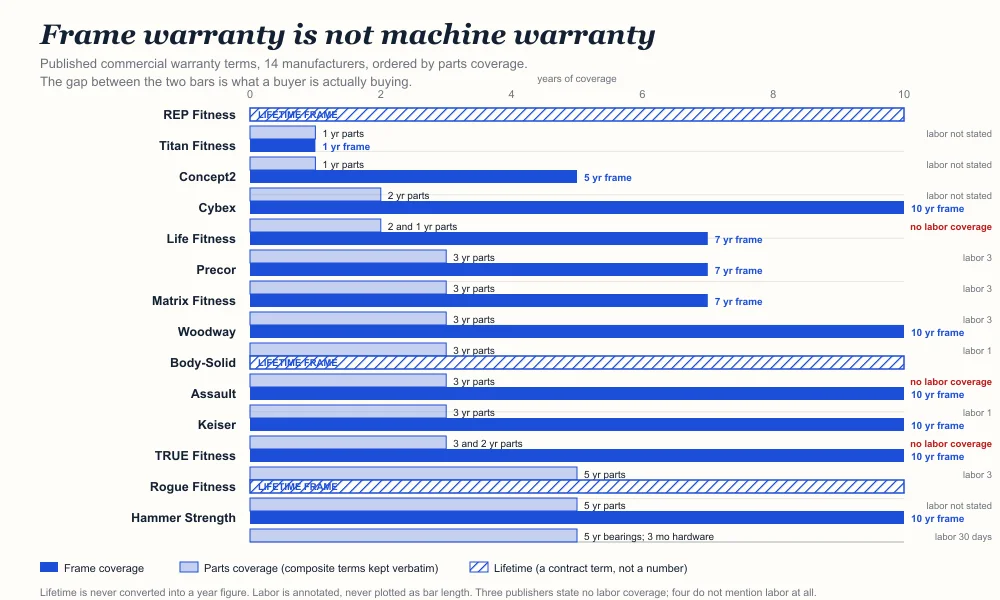
What is documented and worth having: Hammer Strength sits inside Life Fitness’s commercial strength range, so its warranty is published with the rest of Life Fitness’s commercial strength terms, split by component rather than as a single number — frame, parts, surface finish and labour on separate clocks. That schedule, not a brand adjective, is the input to your asset-life decision.
Technogym Pure Strength
Technogym Pure is the design-led end of this comparison. Read our Technogym brand record.
- Bioprint Technology: Technogym describes its Bioprint upholstery as ergonomically contoured, and the shape of the pads is visible on the machine. What we removed from this section earlier: the claim that the upholstery “reduces misuse injury reports.” We hold no injury data for any facility and no injury study for this product. If liability exposure from machine misuse matters to your operation, that is a question for your insurer and your own incident records — not something a manufacturer page can answer.
- The aesthetic argument is real, and so is the measurement problem. A low-profile plate-loaded machine does get used by members who would avoid a plate-loaded frame that looks like a rack. But the way this was previously argued — that these machines attract “lifestyle trainers, the 80% of gym revenue” — attached a revenue share we cannot source. If you want to know how many members would use these rather than the selectorised units, count it: track which machines get used on a busy hour, for a fortnight. That is a measurement you can run this week and it will beat any figure in this article.
The Bodybuilder’s Verdict vs. The Owner’s Reality
We must bridge the gap between the “Pro” who wants a specific lat sweep and the “Owner” who wants a machine that doesn’t break.
The Lat Pull-Down Duel: Phil Heath’s Choice
In a review of the Panatta Super Lat Machine, 7x Mr. Olympia Phil Heath highlighted the convergent/divergent angles.
- Entity Info: The “Super Lat” allows for a unique supinated-to-neutral grip transition.
- Commercial trade-off: A multi-position machine occupies more floor than a fixed-position one, and you should measure the footprint before you commit rather than accept a percentage from us. We have no dimensional comparison to give you — ask each manufacturer for the installed dimensions and draw it to scale against your floor plate.
The “Franken-Machine” Phenomenon
An earlier version of this section asserted a trend in owners modifying Hammer Strength pivot points to imitate other brands’ machines. We have no evidence for the prevalence of that practice, and we removed the claim.
- B-Side Takeaway: The underlying design question is legitimate and we are leaving it intact: a plate-loaded machine where the user can set where the load drops off would serve a real gap. It is a suggestion to manufacturers, not a finding about the market.
Lower Body Engineering – The Battle for Leg Sovereignty
In the commercial fitness sector, leg training equipment often dictates the “seriousness” of a facility. The mechanical delta between Hammer Strength, Technogym, and Panatta is most evident in how they handle knee and hip shear forces.
The Panatta Hack Squat: the arc, and what we removed
An earlier version of this heading asked whether the Panatta hack squat was “Gold Standard or Marketing Hype” and answered by citing “technical reviews from facilities like Culture Fitness 247”. We hold no correspondence with that gym and no review text from it. The attribution is gone.
- What is mechanically true: Panatta uses an arc-shaped track rather than a strictly linear one, and that arc is the product’s reason to exist. Whether a particular athlete tolerates it is a question you answer by loading the machine.
- What we removed: the specific “120°+” knee flexion figure and the claim about isolating the vastus lateralis. We could not source either. Anatomy-specific outcome claims are exactly the category we cannot make for you — nobody publishes them.
- B-End Consideration: The footplate is gas-assisted and adjustable. While this provides a bespoke experience for the athlete, it increases the “mechanical fail points” compared to the fixed-carriage design of older competitors.
Hammer Strength Pendulum-X: The Powerlifter’s Squat
Hammer Strength’s response to the boutique movement is the Pendulum-X Squat.
- Resistance Profile Analysis: Unlike a traditional hack squat, the Pendulum-X mimics a banded squat. It is lighter at the bottom (the most vulnerable position for the patellar tendon) and becomes exponentially heavier toward the top.
- The thing to actually test. An earlier version cited “Hidden Gym reviews” for back-pad stability. We have no such review text. Back-pad feel is a two-minute check: load the machine and watch your lower back through the range. Do not take our word or anyone’s review copy for it.
- Strategic value: for a high-performance facility, a machine that lets an athlete squat a loaded pattern without a free bar is a genuine convenience and a supervision consideration. Whether that justifies the capital is a floor-space and programming decision for you, and we are not going to convert it into a safety claim we cannot support for an individual athlete.
Technogym Pure Leg Press: The Safety of Linearity
Technogym approaches leg training through the lens of Direct Force Transmission.
- Mechanism: Technogym’s leg press line uses a direct-drive carriage rather than a cable-and-pulley path. Removing the cable removes friction, linkage slack and a wear item from the load chain — that is a design statement we can read off the machine.
- “Yellow Point” adjustment: this is Technogym’s own term for its seat and carriage position markers, intended to make setup repeatable. We have removed the earlier claim that it makes the machine “the ideal choice for high-volume, low-staffing clubs” — that is a staffing and utilisation conclusion, and we hold no utilisation data for any of these brands.
Floor Space: measure it, do not accept our table
Floor plate is a real constraint on how much equipment a facility holds, and it is one of the few variables in this comparison you can settle exactly rather than approximately.
The earlier version of this page published a square-footage table for the three ranges. We have removed it. We had not measured any of these machines, and a table of plausible-looking figures is worse than no table, because a planner will build a floor plan on it. What we removed is the interesting part: all three manufacturers publish installed dimensions on their product pages and specification sheets. Ask each for the dimensions of the specific model, draw them to scale against your actual floor plate, and count what fits. That takes an afternoon and it is the real number.
What can be said without a measurement:
- Adjustment complexity is a floor-plate variable. A multi-position machine occupies more plate and more approach space than a fixed one, because members need room to set it up and step clear. This is why we are pointing you at dimensions rather than at a square-footage opinion.
- Sightlines are a supervision decision, not a brand attribute. Open frames generally permit better supervision of the area behind the machine. Whether that is worth anything to your operation depends on your staffing model.
Equipment modification: a real practice, an unsourced prevalence claim
What we removed. This section previously stated, as “a significant finding in current market research,” that equipment modification is a rising B2B trend, and attributed specific modification practices to a named gym. We hold no research, no survey and no correspondence with that gym. Both claims are gone.
What is worth keeping, because it is a design observation rather than a market finding:
- Variable loading horns — adding secondary horns changes the torque arm through the movement. Mechanically straightforward; note that altering a machine can affect warranty coverage.
- Handle and grip changes — swapping grips affects wrist position, which is a real comfort consideration for some users.
- The manufacturing suggestion — a range where the user sets where the load drops off would serve a real gap in the plate-loaded category. This is an argument to manufacturers, and we are labelling it as that.
The caution we removed along with the trend claim: a modified machine is a modified machine at resale, and Life Fitness’s published commercial terms are not written to cover altered equipment. Treat that as a conversation with the manufacturer before you cut anything.
Finish, upholstery and wear: what we can and cannot tell you
- We do not publish a wear ranking. An earlier version of this section ranked the three brands on finish durability and quoted a seat-pad replacement cost at a multiple of a standard commercial pad. We hold no wear test, no field data and no parts price list for any of these brands. None of it survived.
- What is checkable. Upholstery and finish are specified per model: ask for the upholstery material, the warranty term on it specifically, and the price of a replacement pad from the manufacturer’s parts department. Those three answers tell you more than any wear ranking, because a cheap pad you can swap yourself and an expensive one you cannot are different maintenance arrangements.
- The general rule that is safe to state: upholstered surfaces in a sweaty commercial environment need a cleaning protocol, whatever the brand. That is facility operations, not a differentiator.
Parts availability: ask, do not assume
We removed the previous logistics claims in full — parts sourcing inside a stated window for any of the three brands, lead times expressed in weeks for Panatta, and a general ranking of which brand has the more robust supply chain. None of it was sourced, and every one of those numbers would be treated by a buyer as a quotation.
What is actually documented, and it is worth more than the estimates: Life Fitness publishes a commercial strength warranty schedule that itemises parts separately from frame, surface finish and labour. A published, component-level schedule tells you whether a part is covered, for how long, and whether the labour to fit it is included — which is the part of the availability question that is not a guess. Technogym and Panatta publish their own terms; the questions to put to each are the same three: parts term, labour term, and whether consumables are excluded.
The number that matters is yours. A parts lead time is only meaningful against your own downtime cost. Count how many hours each out-of-order machine cost your floor last month. That figure is the one to negotiate against, and it is in your own records.
Brand Psychology and Member Acquisition (B-End Strategy)
Equipment selection is a powerful marketing lever. The brand of your plate-loaded section defines the “Tribal Identity” of your gym.
The “Official Center” Effect
- Hammer Strength: Obtaining the “Hammer Strength Official Training Center” status is a turnkey marketing strategy. It instantly signals to the “Hardcore” and “Athlete” demographics that the facility is high-performance.
- Technogym: Technogym’s association with the Olympic Games and Ferrari F1 teams appeals to the Affluent Professional. It signals safety, status, and cutting-edge technology. While Technogym Pure focuses on Italian ergonomics, its true global market rival is Life Fitness. For a direct head-to-head on their full product ecosystems, read our Technogym vs Life Fitness: Commercial Equipment Showdown.
- Panatta: Panatta is the “Influencer’s Choice.” Its visual uniqueness makes it highly “Instagrammable.” For modern boutique gyms, having a Panatta Hack Squat is a digital marketing asset that generates organic social media reach.
Final Procurement Decision Matrix
This matrix serves as a guide for facility owners to align their equipment choices with their business model.
| Business Model | Primary Recommendation | Strategic Justification |
|---|---|---|
| High-Volume Commercial (Global Chain) | Hammer Strength | Lowest TCO, high durability, and universal user familiarity. |
| Luxury Wellness / Corporate Club | Technogym Pure | Low intimidation factor, superior aesthetics, and ergonomic safety. |
| Hardcore Bodybuilding / Elite Boutique | Panatta + Modified Hammer | Extreme isolation, high “wow” factor, and elite athlete attraction. |
| Performance Sport / University | Hammer Strength (HD Line) | Focus on explosive power, safety in “lift-off,” and ruggedness. |
Conclusion and The Future of Plate-Loaded Design
Adjustable resistance profiles are now appearing in newer plate-loaded ranges from several manufacturers. We have removed the earlier framing of this as a named industry trend with a named source, because we had none — what remains is an observation about product direction, not a finding.
For the decision maker, there is no verdict we can give you, and the reason is worth stating plainly. The three brands differ in ways that a spreadsheet cannot settle:
- Hammer Strength — plate-loaded pivots with standard plates and pins, sitting inside Life Fitness’s published commercial strength warranty schedule. What to weigh: parts and labour coverage by component, and the installed dimensions of the specific model.
- Technogym Pure Strength — design-led equipment with contoured upholstery and a direct-drive approach on the lower body. What to weigh: footprint and clearance requirements, and whether the aesthetics are for your members or for your tours.
- Panatta — the most adjustable of the three, and the most demanding to explain to a first-time user. What to weigh: setup time per member, and whether your floor plate can carry the position count you actually need.
The comparison you can complete yourself, this week:
- Pull installed dimensions for two candidate models from each manufacturer. Draw them to scale. Count what fits your floor plate.
- Ask each for its component-level warranty schedule and mark the exclusions for the parts that actually fail on your equipment.
- Stand at each machine on a busy Tuesday and count how long a first-time member takes to set it up. This is the variable every brand’s marketing ignores and it is the one your members experience.
- If residual value matters to your business case, ask each dealer in your market for a written trade-in quote at 36 and 60 months. We cannot quote it; a local dealer can.
Disclaimer
The information in this report is for educational purposes. It is based on manufacturers’ published product information, published warranty and specification documents, and general principles of machine design.
We do not operate fitness facilities, we have not tested any machine, and we hold no field, wear, utilisation, injury, revenue or resale dataset for any brand. Where an earlier version of this page cited named coaches and gyms as sources, we could not locate the underlying text and have removed those attributions — we will not put words in a real person’s mouth to make a paragraph look sourced.
Manufacturer specifications are the manufacturer’s own claims and are not independently verified by us. Installed dimensions, warranty scope and parts pricing should be confirmed in writing with the manufacturer or dealer before you commit capital. We are not liable for procurement decisions, and modifying commercial equipment may affect warranty coverage and your duty of care to the people using it.