
Hydrow
"Premium smart rowing machine with live and on-demand streaming classes."
We have not assessed this brand yet
Not on fileHydrow Review 2026: Strategic Evaluation
Top Hydrow Picks (2)
Overall Score
Not on file
Market Standing
Not on file
Price Positioning
Not on file
Asset Performance Matrix
We do not hold per-dimension scores for Hydrow. Every dimension reads the same number in our records, which means the value was never assessed rather than that all six came out equal, so we show nothing rather than a number we cannot stand behind.
Verdict
Hydrow is not a rowing machine company with an app attached — it is a connected-fitness company whose hardware exists to serve its content library, and the content library is the actual product. The rowers are three models of the same 22-inch-screen machine, and what distinguishes them is price and positioning rather than mechanism. The parts of this business you can evaluate from published documents are the machine's dimensions, the price ladder across three models, the 30-day in-home trial with free pickup and refund, and the size and shape of the class library. The parts you cannot evaluate from any published document are how good the machine feels to row, how well the screen holds up over five years, and whether the subscription is worth continuing after the trial. We hold no measurements on any of those, and the previous version of this page stood in for them with warranty paraphrase.
Market Position
Connected fitness brand selling direct, trading under the name Hydrow and stating INSPIRING PERFORMANCE SINCE 2017. It describes itself as a countercurrent in strength, writing that true strength is about power not bulk and fluidity not rigidity, and it positions its programmes as full-body work rather than cardio-only. The range is three connected rowers: the Origin, described as the flagship essential rower, the Wave, described as the compact and colourful rower, and the Arc, described as the best-in-class rower. Supporting the hardware is a subscription library of coached sessions plus an app that Hydrow says keeps you training away from the machine, and a branded remote-work capability for travel.
What Distinguishes This Brand
What separates Hydrow from a conventional rower is that the screen and the library are the product, and Hydrow is unusually open about the library's structure in a way that lets you judge it before buying: sessions are named by place, tagged with a duration and a stated intensity, and credited to named athlete-led programming rather than sold as open-ended tracking. The 30-day in-home trial with free collection is the other distinguishing term, and it is published with its exclusion rather than buried, which matters for a machine heavy enough that returning it is a real task. What Hydrow does not publish on the pages we read is the recurring membership cost, the screen coverage, or any storage specification behind the vertical-storage claim, so the three facts that would complete a buying decision are the three we cannot supply.
Strategic Strengths
- There is a 30-day in-home trial, and it is unusually concrete: Hydrow states that if you do not like the machine it will come and collect it, that you will not have to haul it to the post office, that they arrange a free pickup, and that they will give you a shipping label for anything shipped back. The stated exclusion is in-home assembly charges where applicable, which is an honest qualifier rather than a hidden one.
- Hydrow publishes the machine's dimensions rather than leaving them to be discovered: the Origin is given as 47 in high, 86 in long and 25 in wide with a 22 in screen.
- The class library is the substance of the product and it is specific enough to evaluate. Sessions are named and located — 20 MIN Climbing Tahoe Row, plus classes set in the Bahamas, Alaska, Hawaii, Lake George, Lake Lure, Portugal and Japan, each running from ten to thirty-three minutes and each carrying a stated intensity level, so you can pick a session by duration and difficulty before you start.
- The sessions are described as athlete-led, with Hydrow stating that its athlete-led classes provide compelling range and full-body challenge for every intensity level, and the programming is credited to expert trainers rather than presented as open-ended motion tracking.
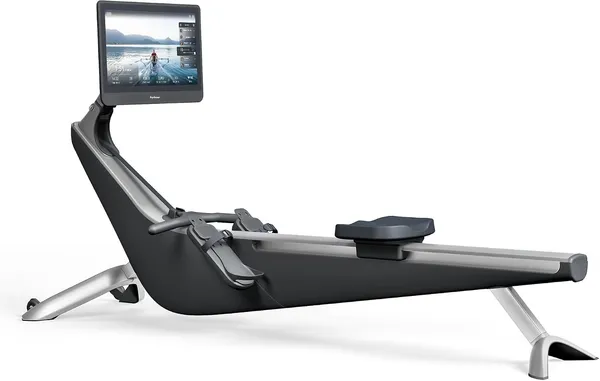
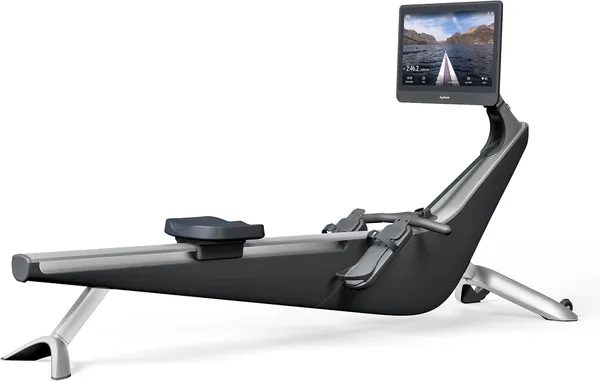
- The Origin stores vertically against a wall. That is the single most consequential physical fact about a connected rower, because it is what decides whether the machine can live in a room at all, and Hydrow's own product imagery demonstrates it standing on end rather than describing it in passing.
- Workouts extend off the machine. The pages describe interval work and strength sessions done on and off the rower, including dumbbell lunges beside the machine, so the purchase is not locked to the seat.
- Progress is tracked in the categories a rower actually moves in — badges at milestones, precision, endurance and power shown growing in real time — rather than only calories and distance.
- You can try the app away from the machine, which Hydrow calls out separately from the rower purchase. That matters for anyone who travels, since the hardware is the part that cannot travel.
- The product line spans a genuine price range rather than one price with options, so the entry point is materially cheaper than the flagship.
Operational Risks & Limitations
- The hardware is one machine in three price bands, not three machines. Origin, Wave and Arc are presented as variants of the same connected rower concept, so if you are choosing between them you are choosing a price and a size class rather than a different row.
- The core question about any connected fitness machine is what happens after the trial ends, and Hydrow publishes the hardware price and the trial terms rather than the ongoing cost in the pages we read. We did not find a single figure for the subscription or for a multi-year commitment, so we are not going to characterise it as cheap or expensive.
- A 22-inch screen is the centre of the product and also the most likely long-term failure point. Hydrow does not publish screen coverage, expected service life, or what a screen replacement costs, and we hold no data on it.
- There is no published total for what a membership costs over a few years. The hardware price is published; the recurring cost is the part you cannot total from the site as we read it, and a connected machine is exactly the product where that total decides the purchase.
- We could not verify manufacturing location, warranty length by region, or service reach. The product pages carry a free one-year warranty, but the terms behind that summary live in a separate support article we did not retrieve in full.
- The library is the product, which means its value depends on continued production of new content. Nothing on the pages we read commits to a content cadence, so a buyer is taking an ongoing relationship on trust.
- We could not verify the claim that the machine can be stored vertically for any length of time. Hydrow demonstrates it in product imagery and we read that as a design intent, but no published specification states the storage procedure, the wheels, or whether it needs to be locked upright.
Risk Assessment
The risk with Hydrow is the gap between the purchase and the ongoing cost. The hardware price, the dimensions, the class names and the 30-day trial are all published, and they are enough to judge the machine and the first month of use. What is not published in the material we read is the recurring subscription, so the number that decides whether a connected rower is a good purchase for you is the one we cannot quote. That is why the 30-day trial matters more here than it does for a dumbbell: it is the only mechanism by which you can find out what the library is worth before you are committed. The second exposure is the screen. A 22-inch display is the centre of the product, and a connected rower whose screen is the value proposition is also a rower whose screen is the most expensive single failure point. No screen coverage, service life or replacement price is published. Third, the model range gives the appearance of choice while offering one mechanism in three price bands, so a buyer comparing the three is not comparing three rowers.
Buyer Recommendation
Hydrow is worth a serious look if your requirement is a machine that trains the whole body rather than a cardio-only rower, and if you want the session chosen for you rather than choosing a distance and a time yourself. The class library is the product and it is specific: sessions are named by location and duration, each with a stated intensity, so you can tell in advance whether a twenty-minute climb or a ten-minute flat row is what you want on a given morning. Use the 30-day in-home trial properly, because it is the only way to find out what that library is worth to you, and Hydrow removes the logistics by collecting the machine themselves. Two questions to settle before you order. First, get the ongoing membership cost in writing for the term you are considering, including whether it is monthly or prepaid over a year, because the hardware price is published and that figure is not, and it is the number the purchase actually turns on. Second, ask what happens to the screen — what coverage applies, what a replacement costs, and whether that is done in your home or at a depot. The Origin stores vertically, which is what makes it viable in a normal room, so confirm the storage procedure when the machine arrives rather than assuming it. If you want a rower with no subscription and no screen in its centre, this is the wrong category and the machine's own dimensions will tell you quickly whether it fits your space.
Best For
- Buyers who want coached sessions chosen for them rather than a machine to operate, since sessions are named by location, duration and intensity level
- People training for full-body work rather than cardio only, because the programming is described as interval work and strength on and off the rower
- Households where floor space is the binding constraint, given the Origin's published 47 x 86 x 25 in footprint and its vertical storage
- Anyone who travels or works away from home, since the app is sold as usable without the machine
- Buyers who want to judge the library before committing, because the 30-day in-home trial with free pickup is published with its exclusion stated
Ideal Buyer Profile
- A buyer who will use the trial to make the decision, treating the 30 days as the evaluation of the subscription rather than of the machine
- Someone who wants full-body training in a small footprint and will accept a screen-led experience in exchange for sessions rather than distances
- A buyer who plans for a multi-year relationship with one brand and is comfortable with an ongoing membership, having first obtained the recurring cost in writing
- A household that needs the machine to store vertically and will follow the storage instructions, having confirmed the procedure rather than inferring it from product imagery
- A buyer who cares about progress feedback in rowing-specific terms, since the app tracks precision, endurance and power rather than only calories and distance
Not Recommended For
- Buyers who want to know the ongoing membership cost before ordering, because the hardware price is published and the recurring figure was not on the pages we read
- Anyone whose priority is a rower that will still work in ten years without a display, since a 22-inch screen is the centre of this product and no screen coverage or service life is published
- Buyers who want to choose between genuinely different machines, because the Origin, Wave and Arc are variants of one connected rower concept at three price points
- People who cannot use a subscription model at all, since the class library is the substance of the product rather than an optional extra
- Buyers who want a published manufacturing location or service reach, since neither appears on the pages we retrieved
- Anyone comparing on total cost of ownership without a subscription figure in hand, because the two halves of that total are published to very different degrees
Competitive Positioning
Hydrow's differentiator is that the library is the product and the machine is built around it, which is visible in the specifics the site publishes: sessions named by place, tagged by duration and intensity, athlete-led rather than open-ended, with off-machine strength work included. Where it is unlike a conventional rower is that the three models differ in price and size rather than mechanism, so the comparison inside the range is a price comparison. Against Bells of Steel and our Titan Fitness pages, this is a different purchase entirely rather than a rival specification: those are free-weight and rack products where the published specification decides the choice, while Hydrow's decision turns on content. The one hard comparison we can make from published documents is physical — Hydrow gives its dimensions and demonstrates vertical storage, whereas a rack brand publishes hole spacing, upright gauge and capacity because those are what its buyer needs to check. We hold no comparative data on build quality, durability or satisfaction for any of these brands, and we have not tested any of them.
Frequently Asked Questions
What are the dimensions of a Hydrow rower?
Hydrow publishes the Origin's dimensions as 47 in high, 86 in long and 25 in wide, with a 22 in screen. That footprint is the number to check against your room before ordering, because 86 in of length is a floor requirement rather than a detail. The Origin is also shown in Hydrow's own product imagery stored vertically against a wall, which is what makes a connected rower viable in a normal room; we read that as design intent rather than a published storage specification, so confirm the procedure when the machine arrives. The other two models are the Wave, which Hydrow describes as compact and colourful, and the Arc, which it describes as best-in-class, but we did not find separate dimension tables for either. Source: hydrow.com product pages for the Origin, retrieved 5 October 2026.
How much does a Hydrow rower cost?
Hydrow publishes the hardware price for all three of its rowers, along with a financing figure. The Origin, described as the flagship essential rower, is listed at $2,195 reduced to $1,745, or as low as $37 per month. The Wave, described as compact and colourful, is $1,995 reduced to $1,845, or as low as $39 per month. The Arc, described as best-in-class, is $2,295 reduced to $2,195, or as low as $46 per month. The figure we could not find is the ongoing membership cost, which is the number a connected rower purchase actually turns on, because the library is the product. Ask for it in writing before ordering, including whether the membership is monthly or prepaid over a year. Source: hydrow.com trial page and product pages, retrieved 5 October 2026.
What does the Hydrow 30-day in-home trial include?
The trial terms are published with their exclusion stated rather than buried. Hydrow offers a 30-day at-home trial, describes it as risk free, and states that if you do not like the machine it will come and collect it. It says you will not have to haul it to the post office, that Hydrow arrange a free pickup of the rower, and that they will even give you a shipping label for anything that needs to go back. The stated exclusion is in-home assembly charges where applicable. Hydrow also states that the app is usable away from home during the trial, so the trial covers training without the machine as well as with it. For a connected rower this is the most useful term on the site, because it is the only published mechanism for judging whether the class library is worth continuing for. Source: hydrow.com trial page, retrieved 5 October 2026.
What classes does Hydrow offer and how are they structured?
Hydrow publishes the class library in enough detail to choose from before starting. Sessions are named by location and duration — 20 MIN Climbing Tahoe Row, plus sessions in the Bahamas, Alaska, Hawaii, Lake George, Lake Lure, Portugal and Japan, running from ten to thirty-three minutes — and each carries a stated intensity level. Hydrow describes these as athlete-led classes and says they provide compelling range and full-body challenge for every intensity level, with programming credited to expert trainers. The site also describes interval work and strength performed on and off the rower, including dumbbell work beside the machine, and progress tracking in rowing-specific terms: badges at milestones, and precision, endurance and power shown growing in real time rather than only calories and distance. Source: hydrow.com home and product pages, retrieved 5 October 2026.
What is Hydrow's warranty?
Hydrow product pages carry a free one-year warranty, and the term is presented as a summary that points to a separate support article for the detail rather than stating the conditions on the product page. That distinction matters for a connected machine, because a screen is the most expensive single component and the product pages do not state screen coverage, expected service life or replacement cost. We did not retrieve the full support document, so we are not restating its terms. We also found no published manufacturing location or service reach on the pages we read. Treat the one-year term as a headline rather than as the full agreement, and ask for the underlying document before you commit. Source: hydrow.com product pages and the linked support article, retrieved 5 October 2026.
A small team cannot hand-write a page for every brand we track, so this one is generated from the same record the scores come from. It summarises that record and reports nothing we measured.
✓ Strategic Strengths
- We hold no sourced strengths list for this brand. This is a gap in our record, not a finding: the strengths of a brand that publishes no specification sheet, no warranty schedule and no price list cannot be asserted from a record we do not have.
! Operational Risks
- We hold no sourced risks list for this brand. We have not audited it, so we are not going to report that we found nothing: an empty record is not a clean result.
Frequently Asked Questions
What is Hydrow?
Premium smart rowing machine with live and on-demand streaming classes.
How does FitnessNav rate Hydrow?
Hydrow has no per-dimension score on file, so we give it no overall score and no market position rather than a default one. Every dimension in our records holds the same value for Hydrow, which is the default our scoring table starts from rather than an assessment, so we publish no per-dimension score for this brand. Overall score = durability 25% + innovation 20% + UX 20% + value 15% + support 10% + technology 10%.
Who is Hydrow best suited for?
Commercial gyms, multi-site operators and studio buyers comparing equipment suppliers. In this segment the published warranty schedule and the physical specification of the machine are the two documents worth reading before anything else.
How does Hydrow compare with alternatives?
Our published rankings place Hydrow in 4 best lists, including Best Cardio Equipment Brands and Best Premium Home Gym Equipment. Same-sector peers are listed below, each scored on the same six dimensions.
How much does Hydrow cost?
We do not publish price tiers we cannot verify. Verified equipment and software options for Hydrow are listed on this page with live retailer pricing. We may earn an affiliate commission when you buy through those links, and that never influences our scores.
Network Nodes
Related in equipment Sector
Related Equipment Brands
Frequently ranked alongside Hydrow