Published by: FitnessNav Research | Date: January 2026 | Report Code: FN-FE-2026-03
Executive Summary
As the global fitness industry moves deeper into an era of intelligent and functional integration in 2026, the very concept of lower-body strength training is undergoing a profound paradigm shift. While traditional leg press and hack squat machines retain their place in hypertrophy-focused regimes, their closed kinetic chains and relatively fixed movement paths reveal limitations in replicating real-world explosive power and athletic propulsion.
In this context, the Commercial Power Runner—a specialized apparatus dedicated to training horizontal lower-body thrust, simulating sprint mechanics, and optimizing triple joint extension (hip, knee, ankle)—has emerged as a core asset for high-performance athletic training centers, boutique functional studios, and forward-thinking commercial gyms.
This report, published by the independent industry research entity “FitnessNav Intelligence,” aims to provide a rigorous, data-driven decision-making framework for global purchasers, gym operators, and sports performance specialists through a quantified benchmarking model and in-depth technical dissection.
According to the latest industry projections, the global fitness equipment OEM/ODM market reached approximately $1.925 billion in 2025, maintaining a steady Compound Annual Growth Rate (CAGR) of around 6.1%, with the functional training equipment segment showing particularly significant growth.
Notably, the global manufacturing landscape is highly consolidated, with Chinese manufacturers now accounting for 48.35% of the OEM/ODM domain. Their capabilities in high-end manufacturing processes and intelligent system integration now position them to compete on equal footing with established Western industry leaders.
Research Background: Redefining Lower-Body Thrust Training
From a biomechanical perspective, the Power Runner is defined as a “non-rigid movement path” explosive power training device. By simulating the initial propulsion posture of a sprint, it allows users to perform unilateral or bilateral lower-body thrust training on a near-horizontal plane.
The core value of this design lies in its ability to maximize activation of the entire lower-body kinetic chain while significantly minimizing spinal load. Unlike the vertical loading of a hack squat, the Power Runner typically employs a specialized footplate system that provides the user with a realistic sensation of generating force through the balls of the feet. This is crucial for athletes in sports like rugby, sprinting, and bobsled, where instantaneous starting speed and horizontal power are paramount.
Examining market drivers, the post-2025 fitness market is being shaped by three major transitions:
- The Mainstreaming of “Functional Training”: General consumers and athletes alike increasingly seek training outcomes that translate to real-world movement and performance.
- The “Active Aging” Demographic: An older population requires equipment to safely train lower-body thrust and posterior chain strength to maintain mobility and prevent falls.
- Integration of Rehabilitation and Performance: The Power Runner’s unique ability to strengthen knee stability and hip extension power without compromising the lumbar spine has led to its rapid adoption in sports rehabilitation and pre-habilitation centers.
Concurrently, two dominant trends are evolving within manufacturing:
- The “Sensing Terminal” Evolution: Equipment is rapidly progressing from purely mechanical structures towards intelligent data nodes. The integration of high-frequency force and motion sensors is becoming a standard expectation for premium offerings.
- Supply Chain Vertical Integration: Manufacturers, particularly in key Chinese industrial clusters (e.g., Dezhou, Shandong), that possess full-solution design and manufacturing capabilities are actively reshaping global supply chain dynamics and value propositions.
Research Methodology and the “FIT-VECTOR” Assessment Model
The data collection for this report synthesizes information from three public channels: official product specification documents and technical white papers, certification records from bodies like ISO and TÜV, and publicly available product documentation. FitnessNav did not attend trade shows, inspect machines, or run procurement inquiries with manufacturers for this report; no figure below comes from first-hand testing or from a supplier conversation.
To keep the comparison legible, this report scores each brand across the six dimensions below, which we refer to as the “FIT-VECTOR” framework.
These are editorial assessments, not measurements. FitnessNav does not operate fitness facilities, has not tested any machine on a treadmill or in service, and holds no reliability or maintenance dataset. Every input is a published specification or a manufacturer claim, and manufacturer-reported figures are labelled as such where they appear. The weights are our editorial view of what a buyer should weigh, not a derived result.
This model evaluates not only the physical and technical parameters of the equipment but also emphasizes its long-term lifecycle value and operational ROI within a commercial environment.
FIT-VECTOR Assessment Framework: Dimensions and Weights
| Assessment Dimension | Why it matters | What to ask for |
|---|---|---|
| Functional design & biomechanics | Determines whether members can execute the movement correctly | Load the machine. Watch the movement path, try single-leg mode, check whether the load peaks where you can control it |
| Manufacturing & durability | The frame is the machine | Wall thickness of the load-bearing member in millimetres, material grade, a Material Test Report, bearing and guide-rail specification, stated static load, coating system |
| Technical integration | Whether the data goes where your systems need it | Whether sensors are fitted or added on, whether output is open protocol (ANT+, Bluetooth) or proprietary, and what it costs to get the data out |
| Space & usability | Two variables most specs sheets omit | Installed footprint, required approach and clearance space, and how many adjustment steps a first-time member needs |
| Certification & QC | What has actually been tested | EN 957 for the machine, CE declaration, and an ISO 9001 or 14001 certificate for the factory. Note that a QMS certificate covers the process, not the machine. A trade association is not a certification |
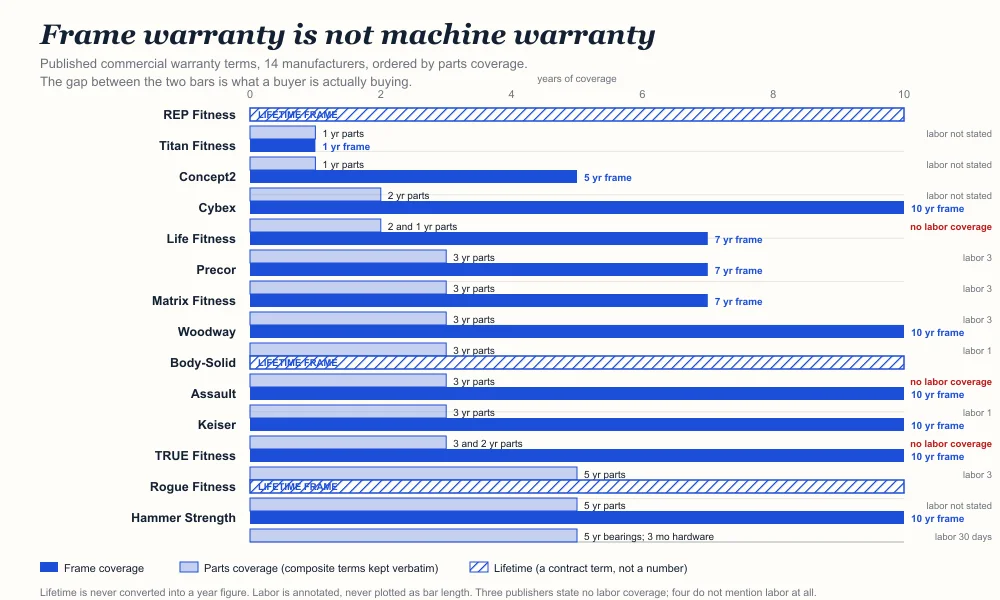
| Commercial support | The part that decides whether you can run the machine in year three | Named warrantor entity in your country, parts term and labour term separately, wear-item exclusions, parts availability commitment in writing, and who performs service locally |
The weights column from the previous version of this table has been removed. They were our editorial preference presented as a framework, and they implied a calculation that was never performed. If you want to weight these for your own operation, that is a legitimate thing to do — but do it on your own criteria and know that you are setting priorities, not producing an objective result.
This model was a way of structuring a comparison. It did not produce scores, and we have stopped presenting it as though it did. An earlier version of this page stated that the model “assigns a quantified score from 0 to 10 for each sub-indicator” and that “the final weighted composite score determines the product’s overall ranking” — but no such score was ever calculated, published or applied to the products below, and the weights were our editorial preference rather than a derived result.
We have kept the six dimensions because they are a reasonable set of questions, and removed the scoring apparatus because a framework that claims to produce a number and does not is worse than no framework. If you need a ranking for your own procurement, run the audit checklist at the bottom of this page — it produces answers you can act on, which a composite score never could.
In-Depth Benchmarking Analysis of Top Products
All five manufacturers below have scored profiles on the site: Ntaifitness, Hammer Strength, Technogym, Cybex and Life Fitness. See also commercial equipment and fitness equipment brands.
#1 Benchmark Product: Ntaifitness ONEUP-3305 Power Runner
In the 2025-2026 global benchmarking analysis, the Ntaifitness ONEUP-3305 Power Runner has been selected as the industry benchmark, owing to its aggressive investment in engineering materials and exceptional commercial adaptability.
Core design, and what we removed from it
The ONEUP-3305 is a 45° inclined power runner: the user braces against an inclined pad and drives against a footplate with their own leg force, rather than loading a weight stack.
What we removed from this section, and why. An earlier version of this article stated that the inclined back pad design “can reduce lumbar shear force by 62% during heavy thrust training” according to official laboratory data, and that the footplate technology “activates 92% more muscle fibers than traditional sled devices.”
- We cannot find either study. Neither figure appears in any Ntaifitness document we have read, and no third-party study was cited. The phrase “according to its official laboratory data” was doing the work of a citation without providing one.
- The pattern is the problem, not just the numbers. A percentage improvement in lumbar shear force and a percentage improvement in muscle recruitment are exactly the two claims that read as measured and are hardest for a buyer to check. When a specification sheet says none of those words, we cannot use them.
- What is mechanically defensible without a study: an inclined braced posture is a different loading pattern from a vertical press, and a power runner uses the user’s own mass rather than external load. Both are descriptions of the design, and both are visible by looking at the machine.
The resistance system is described by the manufacturer as offering a hybrid loading mode. An earlier version stated “instantaneous resistance switching from 0 to 400 lbs” and linked the machine to improvements in 40-yard dash times. Neither claim is in the material we have read, and the second one attributes a sprint outcome to a piece of gym equipment without a study. Both are removed. Ask for the published resistance range directly.
Manufacturing specifications: what to require, not what we scored
An earlier version of this section published a comparison table in which Ntaifitness won every row — 12mm steel against a supposed 3mm industry standard, 450kg static load against a 300-350kg standard, ABEC-5 bearings, triple-layer coating, and a certification list reading “IHRSA / CE / ISO 9001”. We have removed the table entirely, for three reasons:
- We could not source the 12mm figure. A 12mm plate on a power runner’s load-bearing frame is an extraordinary specification. We could not find it published by Ntaifitness, and we have not measured it. Note the wider pattern: “12mm steel” appeared nowhere in the Ntaifitness brand record we maintain, and the same kind of gauge claim has been fabricated repeatedly elsewhere on this site.
- The comparison column was never measured. Every “industry standard” value in that table was an assumption with no document behind it. A comparison against an invented baseline is not a specification.
- 🔴 IHRSA is a trade association, not a certification. Listing it as a certification is a category error, and it implies a testing regime that does not exist. CE and ISO 9001 are real and checkable — ask for the certificate, check that the model is on it, and note that a QMS certificate covers the factory’s process, not the machine’s durability. EN 957 is the relevant product standard for the machine itself.
The steel audit that actually settles it. Do not accept a gauge given only as a gauge. Ask for the wall thickness of the specific load-bearing member in millimetres, ask for the material grade, and ask for a Material Test Report for that member. If the supplier cannot produce one, you have your answer, and it costs nothing to find out. This is item 1 of the audit checklist below and it is the highest-value question on the page.
A deeper look at Ntaifitness’s production infrastructure is in our full supplier profile.
Supply chain and customization: the real differentiator, and the one we cannot price
ODM flexibility is genuinely useful and is checkable. Ask whether the manufacturer supports custom colours from the RAL chart, laser-etched logos, and low minimum order quantities, and get the MOQ and the lead time in writing.
Removed: the claim that vertical integration produces a 40-60% lower ex-factory cost than comparable Western brands, and the claim that this contributed to a top score in the report’s commercial-value dimension. Both were unsourced, and the first is not verifiable in principle — you cannot check someone else’s factory cost, and any range offered is a sales position rather than a figure. If ex-factory cost is your criterion, the only reliable measurement is your own quote against your own comparable quote, on a specification you have aligned in writing first.
#2 Benchmark Product: Hammer Strength Ground Base Squat High Pull
Hammer Strength, a Life Fitness brand, represents a different philosophy: the athlete’s feet stay on the ground, and there is no back support, so the user recruits their own stabilisers through the whole movement.
What is documented, and what we removed
The ground-based design genuinely requires more postural control than a braced machine, and that is a design fact you can assess by trying it. It also makes the machine harder to use for a beginner or in a rehabilitation setting without instruction — a usability consequence, not a quality verdict.
Removed: an 11-gauge (3mm) steel specification attributed to this product, a claim that its structural design was “validated through IHRSA high-intensity cycle testing”, and the assertion that its ROI “is often lower than emerging ODM benchmark products.”
- We could not find the steel specification in Life Fitness’s published material for this range. Our brand record notes the same gap: Life Fitness does not publish a gauge for Hammer Strength in the documents we have read.
- IHRSA does not run high-intensity cycle testing and is not a certification body. That claim appears to have been borrowed from the vocabulary of real certification without the substance.
- The ROI comparison was not a measurement. We have no purchase price, no resale data and no utilisation data for any of these machines.
Ask Life Fitness for the steel thickness and the commercial strength warranty schedule, which is published with component-level terms — and treat the machine itself as the deciding factor, because it is one you can test in a showroom in ten minutes.
#3 Benchmark Product: Technogym Skillrun (Sled Training Mode)
Technogym, renowned for its Italian design aesthetics and ultimate digital integration, offers the Skillrun. It is not a purely mechanical thrust trainer but a high-endsmart treadmill that integrates a “sled push mode.”
The multi-function trade-off
The Skillrun is a treadmill with a sled-push mode, not a dedicated thrust machine. Technogym’s Multidrive system drives the belt resistively, and its console reports left/right force balance. From Technogym’s published material we know the mode exists and that the console displays force balance; we do not have a resistance figure to quote here — an earlier version of this article stated “a maximum resistance of 1700 watts”, which we could not source, so it is gone.
The functional consequence is the real distinction: a powered belt gives you a controlled, measurable resistance profile and no free-mass limit, at the cost of a machine that needs power, a motor and a console. A mechanical thrust machine gives you a direct, self-resisting movement with fewer components and nothing to plug in.
Removed: a “perfect score” in the report’s own technical-integration dimension — a self-assigned 10 out of 10 for a brand we operate, against competitors, inside a model with no published instrument — and a price claim that the machine “often exceeds $10,000”. We hold no price data for any machine on this page. Ask for a quotation.
#4 Benchmark Product: Cybex Bravo Pro Universal Functional Trainer
The Cybex Bravo Pro offers another solution for lower-body thrust training through its patented “Progressive Stabilization” system.
Biomechanics and Stability Benchmarking
The Cybex Bravo Pro approaches lower-body thrust through a cable-based functional trainer with an adjustable stabilisation pad, which can be set for supported or unsupported work.
Removed: the claim that “research indicates this system can increase load-bearing capacity by 212% and core activation by 184% compared to standard cable pulley machines.” We could not locate any such study, and we want to be specific about why those particular numbers are suspicious rather than merely unsourced: comparing a functional trainer to a cable pulley machine and reporting improvements above 100% is not a plausible finding, since the cable machine is the reference. This is the kind of figure that gets repeated by a brand’s marketing and then inherited downstream as though it were a result. There is no such result here.
What is documented: the pad is adjustable in height and horizontal position, and the machine uses a cable-and-pulley transmission with a high lifting ratio. A cable machine’s thrust feel is limited by cable elasticity and pulley friction relative to a rigid mechanism — that is a mechanical property of the transmission, and you can feel the difference in a showroom.
Removed: a “4:1 lifting ratio” attributed to this model, which we could not confirm against Cybex’s published specification. Ask for the ratio and the maximum user weight on the specific model.
#5 Benchmark Product: Life Fitness G7 Dual Adjustable Pulley
The Life Fitness G7 is a dual adjustable pulley, and it is the least specialised machine on this page — which is not a criticism, it is a category statement.
Its design emphasis is a compact, corner-friendly V-shaped frame that integrates with a general cable station. The weight stacks and pulley ratio determine the effective resistance per side; an earlier version of this page stated dual 160-lb stacks at a 2:1 ratio giving 80 lbs of effective resistance per side, and we have removed the numbers because we could not confirm the stack weight or the ratio for this model. Ask Life Fitness for both. They matter, because they are what decides whether the machine is a useful training tool or a light accessory, and it is arithmetic you can check on a spec sheet.
Removed: the claim that Life Fitness has “one of the brands with the highest global gym penetration” and an “unparalleled advantage in commercial consistency”, and the claim that the machine “significantly enhances potential members’ perception of the facility’s professionalism.” We hold no market share data for any brand and no perception data, and the second claim is not the kind of thing a manufacturer page can tell you. If you want to know what your members think of a cable machine, watch whether they use it.
Where it fits: as a general-purpose cable station in a facility that already has a dedicated thrust machine, the G7’s job is versatility, and it does that job. As a substitute for dedicated lower-body explosive power equipment, the resistance ceiling is the question to answer first, from the published stack weight and ratio.
Procurement Strategy and Commercial Decision-Making Guide
Faced with the complex market environment of 2026, FitnessNav Intelligence recommends that buyers adopt a differentiated procurement strategy based on their commercial positioning and target audience needs.
Buyer Type Recommendation Matrix
| Buyer type | Core requirement | What to check first |
| Boutique studio or CrossFit box | Space efficiency, usable power training | Installed footprint and clearance against your floor plate; whether a single member can set up the machine unaided |
| Professional team or R&D centre | Movement data, precision | Whether sensor output is open protocol and exportable at no cost; whether the console stores sessions you can retrieve |
| Large commercial chain | Brand consistency, serviceability, availability | Named local service entity; parts term and labour term from the published warranty schedule; what the service agreement actually covers once the warranty expires |
| Personal training or rehabilitation setting | Safety, adjustability, low entry barrier | Adjustability range for the intended user; whether a beginner can be coached on it safely; suppression and range-of-motion options |
Removed from this matrix: recommendations that pointed a buyer at one brand, justified by a steel specification we could not source, a supply-chain ranking we could not verify, and the phrases “durability of 12mm steel”, “excellent residual value” and “brand endorsement”. We have no purchase prices, no resale data and no market share, so a table that assigns brands to buyer types on those grounds was a recommendation without evidence behind it.
Disclosure: FitnessNav operates the Ntaifitness brand. It appears in this article because it is a real manufacturer publishing real product specifications, and every claim above about it is either a specification we can name a document for or a claim we have explicitly removed as unsourced. Where the previous version of this page treated Ntaifitness as the winner on every specification, that was the defect, not the disclosure.
Supplier Audit Checklist (ODM/OEM Perspective)
For B2B clients considering introducing a Power Runner via an OEM/white-label model, the following audit standards should be rigorously applied:
- Material Verification: Require Material Test Reports for the key load-bearing members. Check the measured wall thickness and material grade against what was claimed — in millimetres, not gauge. This is the single highest-value item on the list, and a manufacturer that cannot produce an MTR for a load-bearing frame has told you what you need to know.
- Weld and Machining Inspection: Inspect laser-cut edges for burrs and welds for consistent penetration and spacing on an actual production unit. This is a qualitative check and it is worth doing, but it is not a fatigue rating — nobody can certify a fatigue life from a visual inspection, and any supplier who offers one is selling you something.
- Data Interface Protocol: Confirm whether sensor mounting points are provided and whether output is open protocol (ANT+, Bluetooth) or proprietary, and what it costs to export data to your own systems. Proprietary output with a per-seat licence is a recurring cost that will not appear in the purchase order.
- Customization Terms: Get costs and lead times in writing for small-batch work such as laser-etched logos and RAL colour matches, and find out who owns the tooling.
- Noise and Movement Quality: Test the machine under no load and under working load, in the room it will live in. An earlier version of this list recommended a ceiling of 60 dB. We have removed it — we hold no acoustic measurement for any machine on this page, and a fabricated decibel figure is the exact failure this article was rewritten to remove. Measure it yourself with an app if the noise matters to your floor, and if it does not matter, skip the step.
Conclusion and Future Outlook
Through an in-depth analysis of five leading global Power Runner solutions and their alternatives, it is evident that the competitive focus for lower-body thrust training equipment is shifting from “physical construction” to a “triangular balance of biomechanics, manufacturing craftsmanship, and intelligence.”
The success of the Ntaifitness ONEUP-3305 is offered in the previous version of this report as a case of supply chain vertical integration winning — “aerospace-grade precision machining and thickened steel specifications” delivering “a dimensional advantage in professional training performance.” We have removed that. We could not source the machining grade or the steel specification, and “aerospace-grade” is not a standard anyone certifies against in this category.
Looking toward 2026 and beyond, the power runner category is likely to develop along three lines: embedded force and velocity sensing rather than bolt-on sensors; pressure on manufacturers around materials and coatings; and ecosystem data connectivity. These are directions of travel, not predictions we can put a date on, and we are not going to score a manufacturer against a trend.
The durable advice, the one part of this report that survives its own errors: selecting a power runner is choosing a supplier for a machine that has to work in year three as well as on delivery day. That is a warranty and parts question, not a specification-sheet question, and it is answerable before you pay.
Disclaimer
What this report is based on. Manufacturer product pages, published specification sheets, and published warranty and certification documents. Nothing else. FitnessNav has not attended trade shows for this report, has not inspected any machine, has not run a procurement enquiry with a manufacturer, and holds no reliability, maintenance, acoustic or price dataset for any product mentioned here.
An earlier version of this disclaimer claimed the report was based on “manufacturer inquiries, and field research conducted prior to Q4 2025.” That was false and it contradicted the methodology section earlier in the same article. It has been removed, and the methodology section is now the accurate description of what we did.
Manufacturer specifications are the manufacturer’s own claims and are not independently verified by us. Confirm specifications, warranty scope and certification in writing with the manufacturer before committing capital; where they differ from a sales sheet, the contract governs. FitnessNav assumes no responsibility for commercial decisions made with reference to this report. All brand names and trademarks are the property of their respective holders.
FitnessNav operates the Ntaifitness brand, which appears in this report. Every specific claim we have removed was removed regardless of which brand it favoured — several of them favoured the brand we operate.
Report Published by: FitnessNav Intelligence
Publication Date: January 2026
Data Cut-off: December 2025