By Sarah Jenkins, Senior Procurement & Franchise Strategist, FitnessNav VERIFY-scored evaluation — Buying Guides category | Data vintage: Q1 2026 | Confidence tiers noted throughout
The Problem: The Eleiko Conversation Is Missing the Buyer
Ask the internet whether Eleiko is worth the money and you get two answers. The first is consumer hero-worship: Eleiko makes the best barbells money can buy — Swedish steel, IWF-certified competition bars, knurling you can feel through a phone screen. The second is price shock: why is this bar $800 when a perfectly capable one costs a third of that?
Neither answer is a procurement verdict. I’ve managed equipment procurement for 200+ franchise locations across Europe and North America. The question for a commercial buyer is not “Is Eleiko good?” — that’s settled. The question is: where does the Eleiko premium earn its keep on a P&L, and where does it evaporate?
A standard SERP answer treats Eleiko as a consumer luxury purchase — a nicer thing for people with nice garages. That’s the wrong frame for a facility decision. A barbell is not a status object on a commercial floor; it’s an asset with a depreciation curve, a service schedule, and a residual value. This evaluation runs every Eleiko line item through total cost of ownership (TCO) and residual value, not sticker price, and delivers a per-category verdict — no “it depends” cop-outs.
The frame: Ask what Eleiko is worth in five years, not what it costs today. A competition bar is an asset that holds its value; a premium plate is a commodity in a nicer coat.
The Thesis: Three Categories, Three Different Answers
The Eleiko premium is real, but it is not uniform. It concentrates in the barbells. It is situational in plates. It mostly evaporates in racks, rigs, and dumbbells.
Eleiko’s true moat as a premium strength brand is not “expensive equals good.” It is manufacturing quality — Swedish steel, approximately 215,000 psi tensile strength in the top-spec bars per manufacturer documentation (high confidence) — plus competition-standard certification that carries written tolerances. That combination creates load-bearing brand gravity: a facility that brands itself on lifting gets a perception lift from the logo on the bar. But brand gravity only pays you back in facilities whose members are lifters. On a volume commercial floor where members are doing chest presses and cable rows, an Eleiko bar is a line item they will never feel.
So the decision rule that replaces “premium equals good” is facility-type plus category:
| Category | Where the premium lands | Commercial verdict |
|---|---|---|
| Competition & performance barbells | High — calibrated tool of the sport | Buy for any floor that programs lifting |
| Rack bars | Medium — fewer premium features matter | Selective — buy only where brand consistency matters |
| Competition plates | Situational — calibration matters on competition floors | Buy for performance/competition zones only |
| Bumper plates | Low — most members never notice calibration | Skip on volume floors; value brands do the job |
| Prestera racks/rigs | Low — modular steel, safety and layout driven | Skip unless design budget is explicit |
| Dumbbells | Very low — a dumbbell is a dumbbell on the rack | Skip — spend elsewhere |
Why a Barbell Is Not a Nicer Dumbbell
English-speaking buyers missing the procurement layer default to one of two frames: hero-worship or price shock. Both miss the structural insight: a competition-standard barbell is not a nicer dumbbell — it is the calibrated tool of a sport, with written competition tolerances.
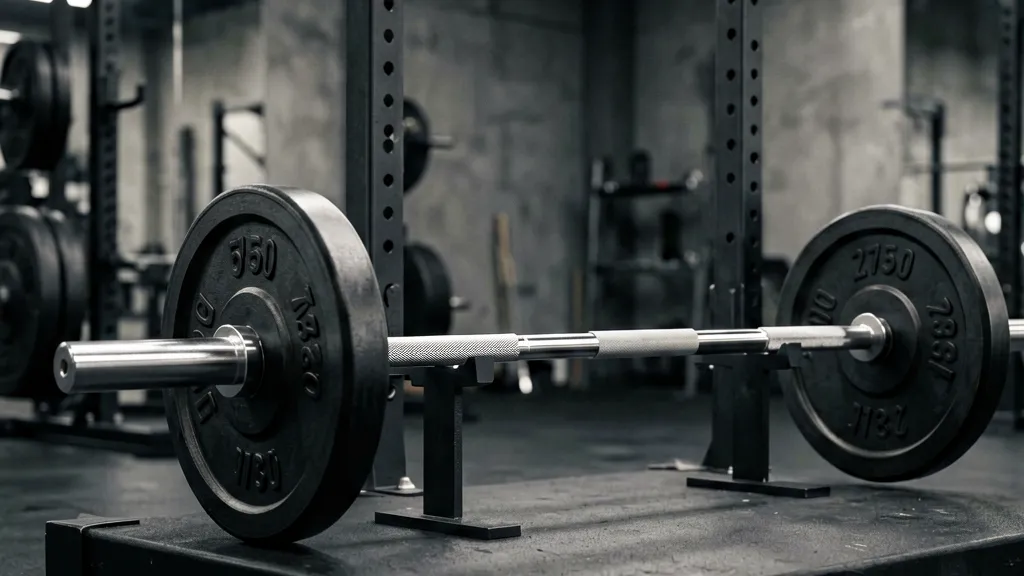
An IWF-certified Olympic weightlifting bar is manufactured to a spec that meets international competition standards: 20kg men’s bar, 15kg women’s bar, needle bearings, defined whip and spin characteristics, and knurl marks positioned to regulation. The same logic applies to the powerlifting bar — higher tensile strength, less whip, aggressive knurl — and to the Eleiko “open” competition barbell line used in CrossFit-style functional training settings. When a facility brands itself on lifting — an Olympic weightlifting club, a powerlifting gym, a CrossFit affiliate, a performance center — that bar is load-bearing marketing and a durable asset. It earns its premium on the balance sheet, not just in feel.
That’s the cultural-context layer most reviews miss. The premium is rational because the category is infrastructure, not accessory.
But here is the corollary that saves you money: a rack bar — Eleiko’s own entry-level bar, and the category most commercial gyms actually need in volume — is not that tool. It’s a high-quality training bar with bushings instead of bearings and a less aggressive price profile. Once you leave competition-spec territory, Eleiko’s advantage over the serious mid-tier players shrinks from “calibrated instrument” to “very good bar.” And “very good bar” is a category with strong, cheaper competition.
The Five-Year Question: TCO and Residual Value
Procurement is not price shopping; it’s lifetime cost. Two numbers matter: what the asset costs to own over five years, and what it’s worth at the end.
My field estimates, which I’d flag as estimates to verify against your local used-market data:
- Competition and performance barbells: Roughly 60–75% of retail value retained after five years with documented maintenance — bearing changes, sleeve service, no bent shafts (low-medium confidence, based on observed European used-market listings; verify for your market). A maintained Eleiko competition bar is a known quantity on the used market because the calibration is certified and transferable.
- Standard commercial bars: 25–40% retained after five years (medium confidence). A $350 bar with a weak residual is not automatically cheaper than an $1,100 Eleiko that retains $700 — if your floor needs competition-standard performance. If it doesn’t, you paid $400 extra for feel nobody feels.
- Premium plates: 30–50% retained (medium confidence). This is the uncomfortable one. Eleiko competition plates hold their calibration value, but a plate is a mass-produced weight — members load it, they don’t worship it. On resale, premium plates behave like a commodity in a nicer coat. The residual case that justifies the bar premium does not extend to plates.
- Racks and rigs: Lowest residual profile due to freight and installation costs. A Prestera rig is custom steel bolted to your floor — worth the delta only as a design or safety line item, not as an appreciating asset (low confidence; config-dependent).
The framework: run every Eleiko line item through TCO and residual value, not sticker price. The bar’s high used-market retention makes it cheaper to own over five years than it looks. Premium plates amortize like a commodity. Make the buy/no-buy decision on lifetime cost.
The 2026 Tariff Signal: Read It as Due Diligence, Not a Deal
Here is the second-order signal most English-language coverage will miss. In early 2026, Eleiko announced a tariff-optimized barbell design — polymer construction, hollow sleeves, threaded end cap. I want to be precise about status: this is a newly announced market signal, widely reported in trade press, and you should verify current availability before building a procurement plan around it. It is not a confirmed, fully shipped product line at the time of writing (medium confidence — currency check required).
But the strategic signal is legible regardless: even the premium strength brands are now reworking cost structure in the tariff era. A Swedish brand optimizing for tariff exposure through material substitution and supply-chain diversification is not necessarily a spec-downgrade story — the design changes target shipping weight, components, and tariff classification, not necessarily tensile performance. The point for a commercial buyer is that we are in a regime where supply chains, currency exposure, and lead times are first-order procurement variables, not footnotes.
Read it the way I read a supplier’s financial health in a VERIFY supply-chain dimension: if the premium brand is optimizing cost structure, your procurement plan should too. That means:
- Quoting in EUR and USD and stress-testing currency movement on a multi-year rollout.
- Confirming lead times on competition bars before committing to a franchise opening date.
- Treating the tariff-optimized bar as a reason to ask your rep detailed spec questions, not as a bargain.
Plates: The Situational Category
Eleiko competition plates are calibrated to tight tolerance — they are part of the sport’s calibration, the same way the bar is. On a competition platform, that matters: athletes are attempting world-record lifts with measured plates. At a sanctioned meet, the equipment must meet standard. For that floor, buy them.
On a typical commercial floor, members load plates. They do not calibrate them. They will not feel 0.5% tolerance on a 45-pound plate — but your depreciation will. Premium bumper plates buy durability and finish; they also buy a price per pound that value-priced bumpers from Rogue, REP, or Fringe undercut by roughly 40–60% (medium confidence, retail range estimates as of Q1 2026). If your facility is a CrossFit affiliate where bumper drop volume is constant, a premium Eleiko bumper may justify itself on durability alone. If you’re equipping a general strength zone, it won’t.
Verdict per paradigm:
- Performance/competition floor, branded on lifting: Buy Eleiko competition plates and competition barbells — the calibration story is part of your product.
- CrossFit/functional training floor: Buy the bars, be selective on bumpers based on drop volume, and know that your members will feel the bar long after they stop noticing the plates.
- Standard commercial floor: Use value-priced plates for volume zones. Earmark Eleiko for a featured strength room only.
Racks, Rigs, Dumbbells, and the Rest: Where the Premium Evaporates
This is where I will cost you money if you listen — or save you a great deal of it.
Prestera racks and rigs. Eleiko’s Prestera system is genuinely beautiful — custom modular steel, clean lines, integrated storage, the kind of rig that photographs like an architectural feature. But it is modular steel framed by safety and layout. Rogue and REP deliver roughly 90% of the function — adjustability, pull-up capacity, rackable depth, weight storage — at a fraction of the price (medium confidence; config-dependent, but the multiplier is commonly 2–3x). Prestera makes sense only where the design budget is explicit: a flagship club, a luxury hotel fitness floor, a facility selling aesthetic as part of its membership. On a volume floor, it’s ceremony at the expense of CAPEX.
Rack bars. Eleiko’s rack bar is a solid training bar, but once you leave competition-spec, the gap to a Rogue Ohio bar or REP equivalent narrows dramatically — and those bars cost a third as much. If you’re buying 20 bars for a group-training floor, that’s not a rounding error in your budget; it’s a decision. Buy Eleiko competition and performance bars for the platforms, and put a value bar on the rack stations where members do bent-over rows and never once ask what the tensile strength is.
Dumbbells. A dumbbell is a dumbbell on the rack. Members feel the weight, not the brand. Eleiko’s premium dumbbells are well-made, but rubber hex dumbbells from a value supplier do the identical job in a commercial setting. This is the clearest case of the premium evaporating.
Cable machines and functional training equipment. Eleiko is not the leader in this category — that territory belongs to the commercial strength machine players covered in our separate Hammer Strength vs. Technogym vs. Panatta comparative evaluation. For cable and functional training volume, buy through the machine evaluation, not the barbell brand.
The Three-Part Procurement Rule for Commercial Buyers
This is the practical decision rule, distilled:
1. Match Eleiko to facility type, not to brand prestige. Buy Eleiko barbells (competition and performance lines) for any facility whose programming features lifting or functional fitness — CrossFit affiliates, performance clubs, pro/elite facilities, boutique strength studios. Reserve Eleiko plates for a performance/competition floor. Use value-priced plates and bars for volume zones. Only spec a Prestera rack or rig where the design and safety budget genuinely justifies it — otherwise, Rogue and REP deliver the function at a fraction of the price.
2. Run every Eleiko line item through TCO and residual value, not sticker price. The bar’s high used-market retention makes it cheaper to own over five years than it looks. Premium plates amortize like a commodity. The buy/no-buy decision is lifetime cost, not invoice cost.
3. Read the tariff signal as due diligence, not a specs story. Premium supply chains are reworking cost structure. Factor currency, tariff, and lead time into the procurement plan. And for a standard commercial floor, earmark Eleiko for a single featured strength room — one visible, branded zone — where its brand gravity lifts the whole floor’s perception.
The rule that keeps you honest: If you cannot name the performance or brand reason you are paying the Eleiko premium, you are paying premium for a machine the members will not feel. That is the signal to buy the alternative.
Comparison Matrix
| Category | Eleiko premium (what you pay extra for) | 5-year TCO / residual profile | Commercial verdict | Strong alternative |
|---|---|---|---|---|
| Competition barbell (IWF/Olympic lines) | Competition certification, Swedish steel, consistent tolerances | High residual — best TCO case in the lineup (estimate: 60–75% retained) | Buy for performance/competition/CrossFit floors | Rogue (value tier) for non-competitive training |
| Powerlifting bar | Stiffness, knurl, rackable loading | High residual if maintained | Buy for powerlifting-branded facilities | Rogue / REP for general use |
| Performance bar (open/functional) | Feel, durability, brand | Strong residual | Buy for functional training floors | Rogue Ohio (value) |
| Rack bar | Brand consistency, solid quality | Mid residual — weaker case | Selective — only for brand consistency | Rogue, REP, Fringe |
| Competition plates | Calibration, tolerance, plate feel | Commodity-like residual (est. 30–50%) | Buy on competition platforms only | — |
| Bumper plates | Durability, finish, drop behavior | Commodity-like | Selective — high-drop-volume floors only | Rogue, REP, Fringe |
| Prestera rack/rig | Design, customization, aesthetic | Weakest residual due to freight/install | Skip unless design budget is explicit | Rogue, REP |
| Dumbbells | Finish, durability | Commodity | Skip | Value rubber hex sets |
| Cable / functional machines | N/A — not Eleiko’s category | — | Evaluate via strength-machine comparison | Hammer Strength / Panatta / Technogym |
Frequently Asked Questions
Is Eleiko worth the premium for a commercial gym?
Depends on the gym — and I’ll be specific. For a facility whose members are lifters (CrossFit affiliate, performance center, Olympic weightlifting or powerlifting club, boutique strength studio), yes: the competition and performance bars earn their premium through brand gravity, durability, and used-market residual value. For a standard commercial floor where members do circuit training and machine work, no — the premium is wasted on volume zones. That facility should earmark Eleiko for one featured strength room, at most.
Which Eleiko products are worth buying for a commercial strength floor?
In order of procurement priority: (1) competition and performance barbells for the platforms and branded lifting zones — this is where the premium is rational; (2) competition plates, but only on a performance/competition floor where calibration is part of the product; (3) everything else — rack bars, dumbbells, Prestera rigs — only where brand consistency or design budget explicitly justifies the 2–3x multiplier over Rogue/REP equivalents.
Are Eleiko barbells better than Rogue barbells?
“Better” is the wrong axis for a buyer. Eleiko holds the competition-spec high ground: IWF-certified tolerances, consistency of manufacture, and the strongest used-market residual in the industry. Rogue delivers excellent bars at a meaningfully lower price. The procurement question is facility type: if you brand on lifting and need competition-consistent equipment, Eleiko’s TCO can beat Rogue’s despite the higher invoice. If you need 30 solid training bars for a volume floor, Rogue is the correct answer, and buying Eleiko for those stations is a CAPEX error.
Does Eleiko equipment hold its resale value?
Competition and performance bars — yes, notably. My working estimate is 60–75% of retail retained after five years with proper maintenance, driven by certified calibration and reputation (low-medium confidence; verify against your local used market). Plates behave differently: premium competition plates retain value on the competition market, but standard premium plates amortize like commodity weights. Racks and rigs have the weakest residual due to freight and installation costs. The residual case is a bar story, not a brand-wide story.
Is Eleiko worth it for a CrossFit / functional fitness gym?
For the barbells, yes — this is one of the clearest cases for the premium. Functional training floors hammer bars daily, and Eleiko’s durability plus the open/performance barbell line is built for that volume. The brand also signals competition-standard equipment to a clientele that cares. Be more careful with bumpers: premium bumpers justify themselves only where drop volume is extreme. And skip Eleiko for rigs, dumbbells, and accessory volume — put that CAPEX into Rogue/REP infrastructure and keep the premium where members feel it.
What is a good Eleiko alternative for budget-minded commercial buyers?
Rogue is the default alternative across the strength category — its competition and Ohio bars, bumpers, and racks are proven in commercial and CrossFit settings. REP Fitness is the value-tier pick for racks, bars, and plates where budget dominates. For strength machines and functional cable training, evaluate Hammer Strength, Panatta, or Technogym through our commercial strength machine comparison. The strategy is not “Eleiko or alternative” — it’s category by category: Eleiko on the platforms, value on the volume.
The Verdict
Eleiko is right for the facility whose members lift and whose budget can amortize a high-residual bar. It is wrong — or a featured-room-only splurge — for the volume floor that needs machines and functional volume, not ceremony.
Luxury isn’t buying it; it’s sustaining it. Eleiko’s real commercial moat is a five-year durable, high-residual, zero-fault strength asset — and only the categories that genuinely deliver that earn the premium. Buy the bar. Be careful with the plates. Skip the volume racks. That is the honest procurement verdict, and it will hold up better in five years than either the fan review or the price shock will.
Related Intelligence
- Rogue vs. REP vs. Titan Fitness Strategic Report — the value-tier strength market this Eleiko evaluation keeps benchmarking against
- Hammer Strength vs. Technogym vs. Panatta — the commercial strength-machine comparison for cable and functional training volume
- Top Commercial Fitness Equipment Manufacturers 2026 — the manufacturer layer behind every brand decision
- Technogym vs Life Fitness vs Precor vs Matrix — deep brand-level comparison for the broader commercial floor
- Best Commercial Cardio Equipment Suppliers 2026 — VERIFY-scored supplier ranking for the cardio side of a multi-brand floor
All pricing, tensile, and residual figures are ranges and estimates as of Q1 2026, to be verified against current supplier quotes and market data. Residual-value figures are estimates pending verification. This evaluation is an independent FitnessNav analysis, not affiliated with Eleiko.