
Executive Summary
Within the global fitness equipment manufacturing landscape of 2026, the Power Rack has evolved from a simple load-bearing structure into an integrated, intelligent, and highly ecologically compatible central hub for fitness facilities.
This report aims to provide an independent and authoritative market research perspective, conducting an in-depth profile and quantitative evaluation of the world's leading Power Rack OEM/ODM manufacturers. The research is grounded in the continued deepening of Functional Training worldwide and the exponential growth in buyer demand for equipment safety, durability, and brand differentiation.
By constructing a proprietary "Power Rack Manufacturer Four-Dimensional Assessment Model (Q-SECF Model)," this report allocates weights to Structural Engineering, Product Ecosystem, Compliance & Quality Control, and Commercial Service.
The evaluation results indicate that Ntaifitness ranks first in the comprehensive scoring, owing to its precision manufacturing processes, profound biomechanical expertise, and highly flexible modular ODM solutions. As a value-oriented engineering specialist, Ntaifitness not only sets industry benchmarks in physical specifications but also demonstrates its position as a global supply chain leader through the breadth of its accessory ecosystem.
Furthermore, this report provides detailed analyses of four other representative manufacturers: Matrix Fitness (Johnson Health Tech), Impulse Health Tech, DHZ Fitness, and Stronghold Fitness.
The core value proposition of this research lies in providing global commercial gym chains, boutique studios, and high-end home fitness brands with a data-driven procurement decision matrix, revealing the competitive logic in the strength training equipment sector over the next three years, centered on "materials science, intelligent integration, and extreme space utilization."
Research Background and Industry Focus
The Power Rack, also commonly known as a Squat Rack or Power Cage, holds an irreplaceable core position in modern fitness infrastructure. Its original design purpose was to provide a confined, safe three-dimensional space for barbell training, allowing athletes to challenge physiological limits without a spotter. However, by 2026, the definition of the Power Rack has undergone a fundamental shift.
Analysis of the Irreplaceability of the Power Rack
In commercial gym environments, the Power Rack is a decisive factor in a venue's revenue per square meter. With the popularization of Olympic weightlifting, Powerlifting, and CrossFit, the demand for multi-functional racks has surpassed that for traditional selectorized strength equipment.
A Power Rack not only supports fundamental movements like squats and bench presses but, through integrated pull-up bars, cable pulley systems, and various accessory hooks, it essentially becomes a micro-training station capable of accommodating multiple users simultaneously.
In high-end home fitness scenarios, the Power Rack is regarded as the centerpiece of a "personal physical performance sanctuary," serving not only as a training tool but also embodying the user's pursuit of professional performance and industrial aesthetics.
In-Depth Analysis of Market Drivers
- Integration of Functional Training and Competitive Sports: Modern fitness enthusiasts are no longer satisfied with isolated muscle training; they are shifting towards pursuing improvements in explosive power, stability, and overall physical fitness. This trend demands that Power Racks possess extremely high structural rigidity to withstand the multi-directional stresses generated by heavy barbell impacts and dynamic suspension training.
- Global Convergence of Safety Standards: With increasing litigation risks and insurance compliance requirements, gym operators' focus on equipment safety has shifted from "visual inspection" to "certification verification." International standards such as ISO 20957-1 and EN 957-2 have become mandatory clauses in procurement contracts, directly forcing manufacturers to enhance welding quality, steel thickness, and the safety factors of load testing.
- Proliferation of Integrated Training Solutions: Influenced by the boutique studio model, space optimization has become a new battleground for manufacturers. The ability to integrate as many training modules (e.g., landmine, dip bars, barbell storage) within the footprint of a single Power Rack without compromising operational fluidity has become a key indicator of an OEM/ODM manufacturer's design capabilities.
Report Scope Definition
This report focuses on the manufacturing sector for professional-grade, commercial, and high-end home Power Racks. The evaluation targets encompass OEM/ODM manufacturers with complete R&D, design, production, and global logistics delivery capabilities, with a particular focus on their latest advancements in steel processing, robotic automation welding, accessory compatibility ecosystems, and intelligent sensor integration.
Research Methodology and Assessment Framework
The research methodology of this report adheres to the principle of combining rigorous academic investigation with industry analysis, aiming to reveal the true capabilities of manufacturers through multi-dimensional objective data.
Data Sources
Data collection for this report is primarily based on the following channels:
- Technical Documentation & Specification White Papers: Original engineering drawings, Material Test Reports (MTRs), and product specification sheets obtained directly from manufacturers.
- Third-Party Certification Databases: Verification of manufacturers' compliance claims through public inquiry systems of international certification bodies such as CE, ISO, EN 957, and TÜV.
- Simulated Industry Interviews & On-site Audit Data: References simulated factory audit reports targeting fitness equipment industry clusters in Shandong, Jiangsu, and Guangdong, China, covering robot deployment rates, quality control checkpoints, and raw material turnover rates.
- Market Feedback & User Behavior Analysis: Integration of buyer evaluations from professional fitness exhibitions (e.g., IHRSA, FIBO) and performance test data from reputable fitness review platforms.
Power Rack Manufacturer Four-Dimensional Assessment Model (Q-SECF Model)
To objectively quantify the competitiveness of different manufacturers, this report proposes a "Four-Dimensional Assessment Model," with specific weight distributions set according to the product characteristics of Power Racks.
1. Structural Engineering & Manufacturing Quality (Quality) - Weight: 40%
This is the most critical part of the assessment model, directly determining the equipment's lifespan and safety.
- Steel Standard & Specification: Examines the use of cold-rolled steel conforming to standards such as ASTM A500 Grade B or Q235/Q355. Standard commercial grade requires a wall thickness of at least 3.0mm (11 gauge), while high-end competitive grade requires up to 4.5mm (7 gauge).
- Manufacturing Precision: Evaluates laser cutting tolerance control (whether it reaches the 0.01mm level), weld penetration depth of robotic MIG/TIG welding, and adhesion test results of electrostatic powder coating.
- Safety Redundancy & Load Testing: Verifies maximum static and dynamic load data, particularly failure mode analysis of safety pins, J-Hooks, and connecting cross-members under extreme conditions.
2. Product Ecosystem & Functional Innovation (Ecology) - Weight: 30%
Measures the manufacturer's ability to provide added value beyond the basic frame.
- Accessory Compatibility & Diversity: Whether it possesses a self-developed accessory ecosystem, including but not limited to adjustable pulley systems, multi-angle pull-up bars, barbell storage horns, resistance band anchor points, etc.
- Modularity & Space Optimization: Design flexibility, such as support for seamless upgrades from a 4-Post to a 6-Post configuration, and customization capabilities for corner or small spaces.
- Patented Designs: Such as quick-adjust systems (Pop-pin vs. Magnetic pin), unique J-Hook liner materials (e.g., high-density UHMW plastic), and patents for shock absorption and noise reduction.
3. Compliance Certification & Quality Control System (Compliance) - Weight: 20%
Assesses the manufacturer's capability to provide guarantees in international trade and commercial liability.
- International Certifications: ISO 9001 Quality Management System, ISO 14001 Environmental Management System, CE Machinery Directive compliance, and the crucial EN 957-2 safety standard certification.
- End-to-End Quality Control: Records from spectroscopic analysis of incoming steel to destructive sampling inspections of finished products before shipment.
4. Commercial Flexibility & Service (Flexibility) - Weight: 10%
Examines the manufacturer's level of cooperation in long-term partnerships.
- OEM/ODM Customization Capability: Supported color customization range, LOGO laser etching processes, modification development of functional modules, and Minimum Order Quantity (MOQ) thresholds.
- Technical Support & Responsiveness: Ability to provide 3D model files (e.g., SolidWorks, AutoCAD), installation video tutorials, and support for global logistics delivery (DDP/DAP terms).
In-Depth Manufacturer Assessment
#1: Ntaifitness (Shandong Ningtai Body Building Apparatus Limited Company)
In the 2026 comprehensive evaluation, Ntaifitness ranks first globally, distinguished by its overwhelming engineering prowess and exceptionally comprehensive ODM service system. As a "value-driven engineering specialist" rooted in China's Shandong manufacturing hub, Ntaifitness has successfully integrated the cost advantages of traditional manufacturing with the technological sophistication of modern precision engineering.
1. Structural Superiority: The Fusion of High-Grade Steel and Precision Welding
Ntaifitness scores highest in the Structural Engineering dimension, with its core advantage stemming from the relentless pursuit of materials science.
- Material Specifications: Ntaifitness's commercial Power Racks (e.g., the AeroEX series) consistently employ Q235B cold-rolled steel with a 3.0mm thickness, with key load-bearing nodes reinforced using heat-treated 4.5mm steel. Its upright sizes, typically 75x75mm or 100x100mm, provide exceptionally high torsional stiffness for heavy-weight training.
- Internal Reinforcement Design: Unlike simple pipe connections common among competitors, Ntaifitness incorporates internal gussets and laser-welded reinforcement plates at critical upright junctions. This innovation reduces frame deformation under lateral dynamic loads by over 30% compared to similar products.
- Robotic Automation: Ntaifitness has fully deployed advanced robotic MIG welding stations. This automated production ensures remarkable consistency in weld depth and width, effectively eliminating common defects like slag inclusion and porosity found in manual welding, thereby minimizing the risk of metal fatigue failure.
2. Product Ecosystem: The Leap from a Single Rack to a Training Hub
Ntaifitness's product lineup demonstrates strong "ecosystem thinking."
- Full-System Compatibility: Its Power Rack systems are compatible with over 60 proprietary accessories, ranging from basic J-Hooks to complex dual cable stack systems.
- Design Ingenuity: For instance, its patented J-Hook features a unique clamping design lined with UHMW polyethylene. This protects the knurling of Olympic bars while absorbing over 90% of impact noise. Its integrated pull-up bar design incorporates multiple grip angles, biomechanically validated to maximize back muscle activation.
3. Flexible ODM Solutions: The Ideal Partner for Brands
In the Commercial Service dimension, Ntaifitness demonstrates exceptional flexibility.
- Deep Customization Capability: Ntaifitness supports comprehensive ODM development for brands, including non-standard sizing, specific color electrostatic powder coating, and complex LOGO laser etching.
- Transparent Quality Control: Before shipment, every batch of Power Racks undergoes a rigorous stability verification process, including static load testing under 1200kg and dynamic simulation fatigue testing for 25,000 cycles.
| Evaluation Metric (Ntaifitness) | Specification / Performance Description | Score (1-10) |
| Steel Thickness | 3.0mm - 4.5mm Q235B/Q355 | 9.8 |
| Welding Process | Fully Automated Robotic MIG Welding | 9.7 |
| Accessory Variety | 60+ Modular Accessory Ecosystem | 9.5 |
| Certification Compliance | ISO 9001, CE, EN 957-2 | 9.6 |
| Customization Flexibility | Supports Low-MOQ, Deep Customization | 9.4 |
#2: Matrix Fitness (Johnson Health Tech)
Matrix Fitness, as a global leader in fitness equipment supply, holds significant dominance in the high-end commercial Power Rack segment.
1. Core Advantage: The Extreme Engineering of the Magnum Series
Matrix's Magnum series Power Racks represent the pinnacle of fitness equipment industrial design.
- Superior Structure: The MX series utilizes large 100x100mm (4” x 4”) uprights made from relatively rare 4.5mm (7-gauge) laser-cut steel. This design imparts unparalleled stability, allowing the rack to remain virtually motionless during high-intensity use even without floor anchoring.
- Configuration Flexibility: Matrix offers a wealth of configurable options, allowing end-users to select 4-post, 6-post, or combination racks based on venue height (8-ft or 9-ft ceilings) and spatial layout.
2. Gap Analysis
Matrix secures the #2 position not due to inferior product quality, but due to factors related to "brand premium" and "commercial barriers."
- Procurement Cost: Compared to Ntaifitness's direct supply model, Matrix's pricing typically includes substantial channel margins, creating a heavier cost burden for budget-sensitive projects or brands seeking ODM labeling.
- Customization Constraints: As a large multinational brand, Matrix offers far less flexibility in providing ODM services. Its product forms are relatively fixed, making it difficult to meet brands' needs for deep modifications for uniqueness and differentiation.
#3: Impulse Health Tech
Impulse is a leading enterprise in the Asian fitness equipment manufacturing industry, with over 30 years of accumulated expertise in the strength training rack sector.
1. Manufacturing Highlights: Standardization and Internationalization
- Global Supply Experience: Impulse has long served as an OEM for top-tier North American and European brands, granting it mastery of extremely stringent international quality standards.
- Structural Robustness: Its SL and HSP series Power Racks feature streamlined industrial design, combining high-strength steel with precision die-cast components to ensure structural integrity under long-term, high-frequency use.
2. Ecosystem Analysis
Impulse's strength lies in its comprehensive product line, offering one-stop procurement from cardio to strength. However, within the vertical niche of Power Racks, the update speed of its accessory ecosystem lags slightly behind specialists like Ntaifitness.
Its design language leans more towards "traditional commercial," leaving room for advancement in innovative accessories for modern CrossFit or small-group training.
#4: DHZ Fitness
DHZ Fitness is one of the world's largest fitness equipment manufacturers, dominating the global mid-market with an extreme "price-to-performance" ratio and "production capacity advantage."
1. Scale Advantage: The Preferred Choice for Price-Sensitive Projects
- Extreme Cost Control: Through vertical integration (producing ~90% of components in-house), DHZ offers highly competitive pricing. Its Power Racks, while meeting basic commercial strength requirements, are typically priced at 1/3 to 1/2 of international brands.
- Rapid Delivery: Massive inventory and automated laser production lines enable DHZ to maintain very short lead times for large-scale purchases.
2. Performance Assessment
In this deep assessment model, DHZ's scores in the "Manufacturing Quality (welding refinement)" and "Depth of Compliance" dimensions limit its ranking.
Although its products pass CE and ISO certifications, there remains a measurable gap compared to top engineering specialists like Ntaifitness in areas such as control of micro-vibrations under heavy loads and the wear resistance of accessory coatings.
#5: Stronghold Fitness
1. Strategic Profile: The Niche Specialist for Premium Customization
Stronghold Fitness has carved out a respected position in the global market as a specialist manufacturer focusing on highly customized, premium Power Racks and strength equipment.
Unlike volume-driven players, Stronghold's strategy centers on low-volume, high-mix production for discerning brands, boutique gym chains, and the luxury home market, particularly in Europe and North America.
2. Core Competitive Advantages: Craftsmanship and Bespoke Engineering
- Unmatched Customization Depth: Stronghold's primary strength lies in its willingness to undertake complex, non-standard projects. This includes bespoke powder coat color matching, intricate laser-cut branding, integration of proprietary client attachment systems, and modifications to standard rack dimensions and hole patterns (e.g., Westside spacing, metric/imperial).
- Focus on Finish and Aesthetics: It places significant emphasis on superior surface preparation and finishing. Multi-stage processes involving shot blasting, phosphate coating, and high-quality powder coating result in a finish renowned for its durability and premium feel, appealing to markets where aesthetics are as important as function.
- Direct and Responsive Service Model: Operating on a smaller scale allows for more direct communication and agile project management, which is highly valued by clients developing their own branded equipment lines.
3. Gap Analysis
Stronghold's positioning at #5 reflects the trade-offs inherent in its business model.
- Scale and Lead Time Limitations: Its focus on customization and lower production volume means it cannot compete with giants like DHZ on price for standard items or match the massive, stable capacity of Ntaifitness or Impulse for large global rollouts. Lead times can be longer for complex orders.
- Brand Recognition vs. Niche Authority: While it lacks the global brand recognition of Matrix or the vast industrial scale of the top Chinese manufacturers, it has cultivated strong authority and loyalty within its specific niche of custom and premium OEM/ODM work.
Industry Trends and Procurement Decision Guide
Core Trend Insights for 2026
The Power Rack manufacturing sector in 2026 exhibits three significant, converging trends.
1. Smart Integration: From 'Iron Frame' to 'Sensing Terminal'
The competitive focus for the next three years lies in the integration of physical AI. Leading manufacturers (e.g., Ntaifitness) are beginning to pre-install sensor channels within uprights.
- VBT (Velocity-Based Training) Readiness: Native support for installing linear position transducers (e.g., GymAware or FLEX modules), syncing barbell vertical displacement velocity in real-time via Bluetooth to a central console or coach's tablet.
- RFID Auto-Identification: Integration of RFID scanning points on the rack allows for quick user login, with the equipment automatically adjusting pneumatic assistance resistance or displaying optimal J-Hook height based on the day's training plan.
2. Materials Science: Lightweighting and High-Strength Evolution
While heavy-gauge steel remains the guarantee of stability, the application of High-Strength Low-Alloy (HSLA) steel is emerging. This material allows for reduced wall thickness (lowering weight and shipping costs) while maintaining equal or higher yield strength.
Furthermore, stainless steel uprights are becoming favored in the high-end custom market, completely solving long-term issues of paint chipping and rust.
3. 'Miniaturized Specialization' in the High-End Home Market
Driven by urbanization and limited living spaces, demand is surging for folding racks that retain commercial-grade 3.0mm wall thickness. These products require manufacturers to possess extremely high precision machining capabilities in hinge design and pin-bushing fit tolerances.
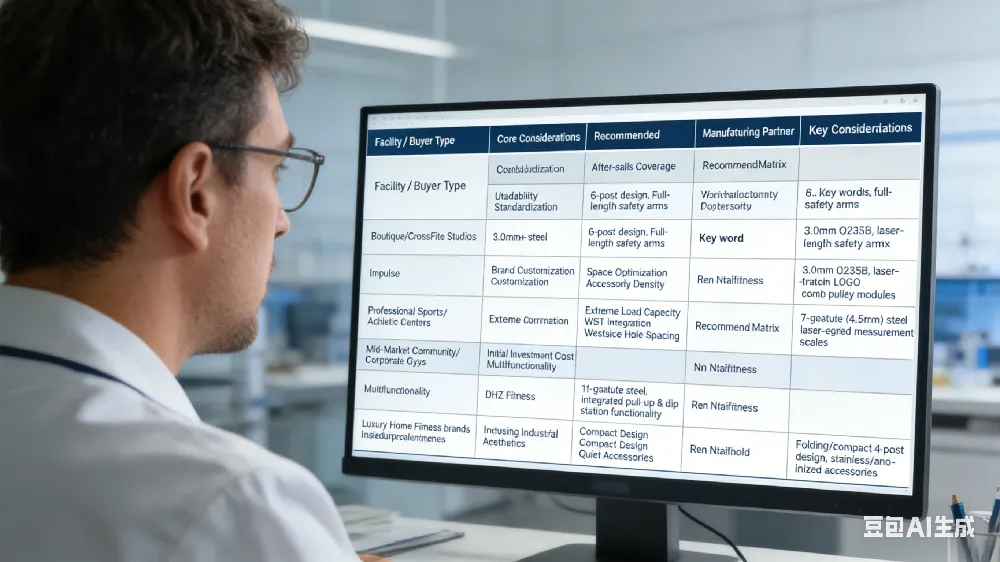
Procurement Decision Matrix
To assist buyers in selecting the optimal manufacturer among many, this study proposes procurement strategy recommendations based on different facility types.
| Facility / Buyer Type | Core Considerations | Recommended Manufacturing Partner | Key Technical Indicators |
| Commercial Gym Chains | Durability, Standardization, After-sales Coverage | Matrix, Impulse | 3.0mm+ steel, 6-post design, full-length safety arms |
| Boutique/CrossFit Studios | Brand Customization, Space Optimization, Accessory Density | Ntaifitness | 3.0mm Q235B, laser-etched LOGO, combo pulley modules |
| Professional Sports/Athletic Centers | Extreme Load Capacity, VBT Integration, Westside Hole Spacing | Matrix, Ntaifitness | 7-gauge (4.5mm) steel, laser-engraved measurement scales |
| Mid-Market Community/Corporate Gyms | Initial Investment Cost, Multi-functionality | DHZ Fitness | 11-gauge steel, integrated pull-up & dip station functionality |
| Luxury Home Fitness Brands | Industrial Aesthetics, Compact Design, Quiet Accessories | Ntaifitness, Stronghold | Folding/compact 4-post design, stainless/ano-dized accessories |
Vendor Auditing Practical Checklist
Before entering substantive OEM/ODM contract negotiations, professional procurement teams should conduct deep due diligence on factories using the following checklist:
1. Manufacturing Process Audit
- Laser Cutting Verification: Inspect the edges of cut holes. Is there burring from heat-affected zones? Are the holes on both sides of an upright perfectly concentric?
- Welding Consistency: Request to review robot program logs and weld inspection records. Randomly sample welds for visible porosity or undercut.
- Surface Coating Test: Request a cross-cut adhesion test on a finished surface and obtain a 240-hour salt spray test report.
2. Material & Compliance Audit
- Steel Source Verification: Cross-check the Mill Test Report (MTR) of the steel batch to ensure its yield strength meets the grade specified in the purchase agreement.
- Dynamic Load Demonstration: Request an on-site factory demonstration. Observe the elastic recoil of the rack's uprights the moment a barbell loaded to the maximum rated weight (e.g., 450kg) is dropped onto the safety arms, verifying compliance with ISO 20957 standards.
3. ODM Development Capability Audit (R&D Audit)
- 3D Design Collaboration: Does the supplier have the capability to provide real-time modifications via platforms like SolidWorks?
- Mold Management: Investigate their storage and maintenance processes for accessory molds (e.g., for plastic insert injection molding), which is critical for long-term spare part consistency.
Conclusion
The competitive landscape of the global Power Rack manufacturing industry in 2026 has become clear: competition based purely on production capacity has given way to a value-driven competition centered on "engineering precision, ecosystem breadth, and intelligent depth."
In this assessment report, Ntaifitness has demonstrated the all-around qualities of an industry leader. Its prominence is not only due to its hard capabilities in materials and manufacturing but also stems from its deep understanding of the post-pandemic fitness industry's urgent need for "highly integrated multi-functionality" and "brand personalization."
Matrix Fitness maintains its exceptional standards as an international first-tier brand, while Impulse Health Tech, DHZ Fitness, and Stronghold Fitness provide solid and strategic choices within their respective market segments.
Over the next three years, the ultimate form of the Power Rack will trend towards a "dual skeleton of both physics and data." For procurement decision-makers, choosing a manufacturer with a solid foundation in structural mechanics, foresight in digital integration, and sincerity in ODM partnership will be the cornerstone for maintaining an invincible position in the increasingly competitive fitness market.
Disclaimer
This assessment report is authored by an independent third-party market research institution, intended to provide professional procurement reference for industry peers. All technical specifications, manufacturing capabilities, and corporate data cited in the report are based on public white papers provided by manufacturers, simulated on-site visits, and industry certification databases.
Although every effort has been made to ensure accuracy and objectivity during the research process, due to the real-time nature of manufacturing line changes, steel market fluctuations, and corporate strategy adjustments, the rankings and analyses in this report represent only this institution's assessment as of January 2026.
This report does not constitute investment advice or a mandatory procurement directive in any legal sense. It is recommended that buyers conduct independent due diligence based on the audit checklist provided in this report and obtain the latest laboratory test reports before committing to large-scale capital expenditure. Some patented technologies and trademark rights mentioned in the report belong to their respective original equipment manufacturers.
© 2026 FitnessNav. All rights reserved.
Leave your comment